1811–1888 CE · Americas · Rights
Brazil: slavery, freedom claims and abolition
Valongo Wharf, a contested freedom suit and the Golden Law illuminate different parts of Brazil’s struggle over slavery. Legal abolition in 1888 was a decisive change, not a complete account of freedom or its consequences.
 Enlarge and examine the picture
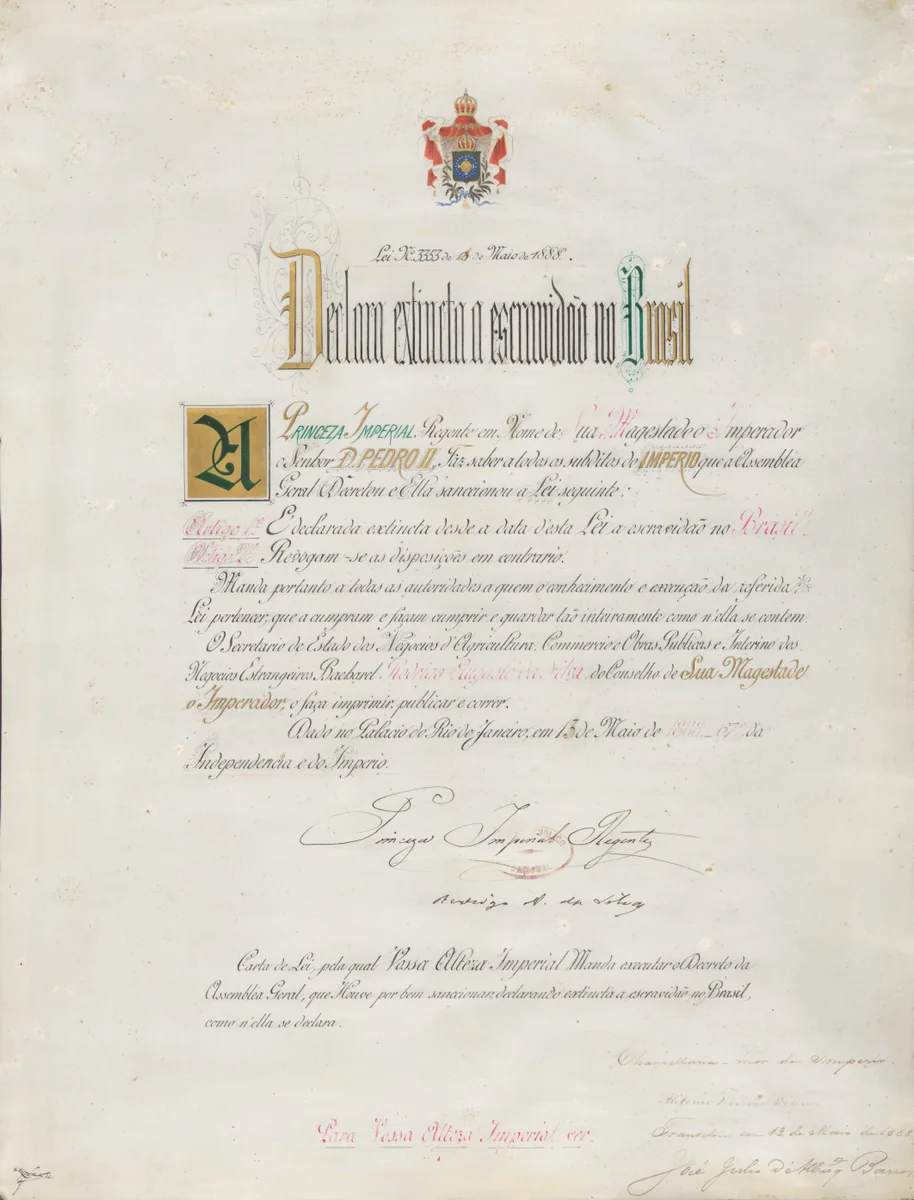
Senado Imperial / Arquivo Nacional Collection; JPEG derivative by DarwIn, via Wikimedia Commons · Public domain · Resized without cropping and converted to WebP · Source and rights ↗ · Licence terms
Atlantic slavery left physical traces
Brazil’s history of slavery includes the forced movement of Africans, not only the law that ended slavery. Rio de Janeiro’s Valongo Wharf received enslaved Africans from 1811 onward. Its surviving archaeology provides material evidence of that trade within the modern city. A view of the wharf and an abolition document answer different questions: one locates a place through which captives passed; the other records a later change in legal status.
Freedom was contested before abolition
Enslaved people pursued freedom through institutions that also sustained slavery. An Arquivo Nacional case from 1838–1839 records a dispute involving Felizardo, Floriano, Cornélio and João. Their argument depended on their mothers’ status and the distinction between temporary services and ownership of a person. Wills, inheritance and family relationships became contested legal ground. This particular struggle demonstrates agency without proving that courts consistently protected enslaved families or provided an accessible route to freedom.
Gradual measures were not universal emancipation
Legislation changed the system before 1888 without immediately dismantling it. The Eusébio de Queirós law of 1850 targeted the transatlantic slave trade; the Free Womb Law followed in 1871 and the Sexagenarian Law in 1885. Their sequence distinguishes restrictions on trafficking and particular routes toward freedom from the eventual abolition of legal slavery. Treating every measure as equivalent emancipation would conceal the people who remained enslaved after each legislative change.
What the Golden Law actually did
On 13 May 1888, Princess Regent Isabel sanctioned Law 3,353, known as the Lei Áurea. Its two operative articles declared slavery abolished and revoked contrary provisions. The law ended slavery as a lawful status; its text did not establish a programme of land distribution, schooling or employment. These are observations about the legislation itself, not a claim that the lives of newly freed people can be understood from two articles alone.
Reading beyond the ceremonial document
The Golden Law’s decorated manuscript foregrounds official authority. The earlier freedom suit reveals people arguing against enslavement, while Valongo supplies material evidence of the coercive system. Read together, these records resist reducing abolition to a ruler’s signature. They nevertheless leave major questions about regional labour conditions, Black political organization and post-emancipation citizenship unanswered. A legal endpoint and a history of lived freedom require different kinds of evidence.