626–539 BCE · Middle East · Culture
Babylon: a city of colour, ritual and knowledge
Babylon was more than the setting of a conquest. Its glazed-brick streets, temples and scholarship reveal an urban society whose influence outlasted its imperial government.
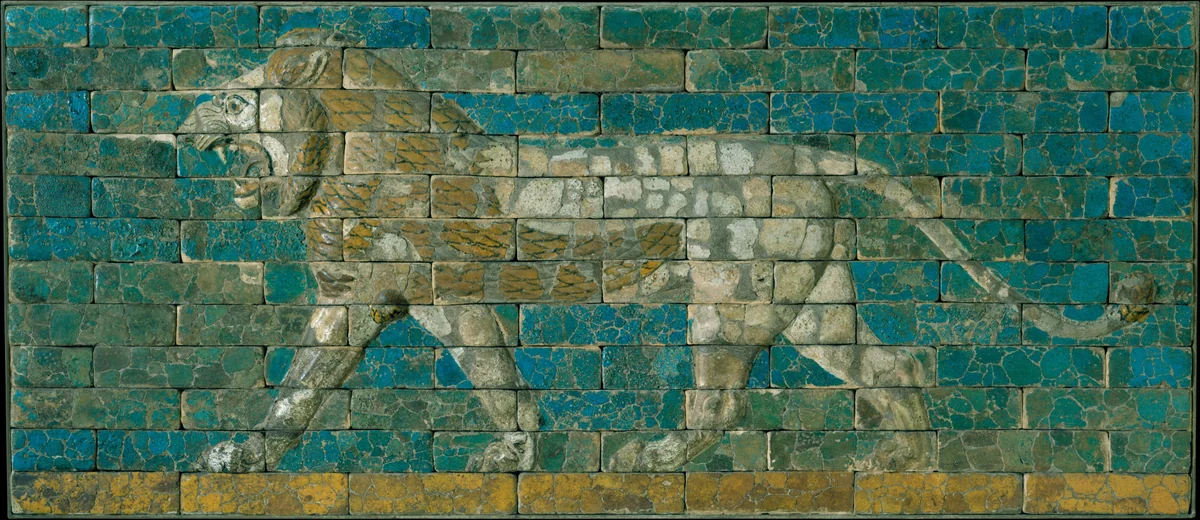 Enlarge and examine the picture
The Metropolitan Museum of Art · Fletcher Fund, 1931 · 31.13.1 · Public domain / CC0 · Resized and converted to WebP · Source and rights ↗ · Licence terms
A city with more than one imperial past
The Neo-Babylonian capital flourished between 626 and 539 BCE, but Babylon had a much longer history, including the earlier reign of Hammurabi. These were different periods. Walls, gates, palaces, temples and surrounding agricultural land form part of the surviving archaeological landscape; the city cannot be reduced to one king or one biblical episode.
Follow the lion along the Processional Way
The pictured glazed-brick lion belongs to the street north of the Ishtar Gate. Lions associated with Ishtar accompanied a ceremonial route connecting the city with the New Year festival house. Bulls and dragons on the gate represented other deities. Repeated animals were therefore part of an ordered religious and royal landscape, not simply ornament on an isolated museum object.
Materials, skilled work and learning
In southern Mesopotamia, builders made extensive use of clay rather than readily available building stone. Moulding, firing and glazing allowed craftspeople to assemble colourful architectural reliefs. Babylon also left a substantial mathematical and astronomical legacy. An account of imperial warfare needs this complementary history of urban work, ritual and knowledge.
Read the remains without inventing the missing city
The museum panel is a surviving architectural object assembled for display, not an untouched stretch of ancient street. The Hanging Gardens belong to Babylon’s powerful later reputation, but a confident modern picture of their exact layout would go beyond the evidence presented here. Modern restoration and archaeological remains must also be distinguished when reading site photographs.