1880–2015 CE · Americas · Rights
Canada: residential schools, resistance and Indigenous survival
Content note: institutional abuse and a historical photograph of Indigenous people who have died. Residential schools sought assimilation; Indigenous resistance and Survivor testimony are central to understanding the system and its consequences.
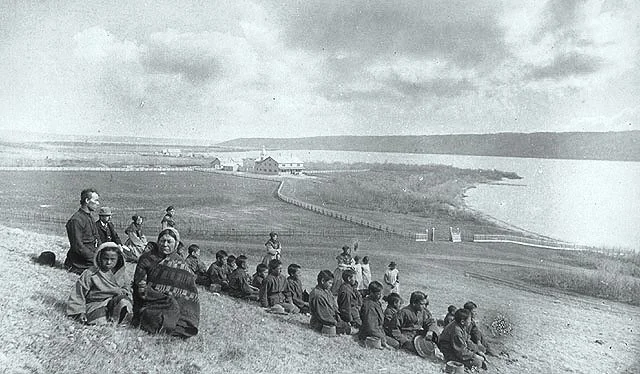 Enlarge and examine the picture
O. B. Buell / Library and Archives Canada, PA-118765, via Wikimedia Commons · Public domain · Resized without cropping and converted to WebP · Source and rights ↗ · Licence terms
An assimilation system
Residential schools separated Indigenous children from families and communities under policies intended to undermine Indigenous identities. Earlier institutions preceded the federal system’s major expansion from the 1880s. Churches administered many federally funded schools. The National Centre for Truth and Reconciliation estimates that more than 150,000 First Nations, Inuit and Métis Nation children attended over its long history. These distinct peoples did not all encounter identical institutions, laws or experiences.
Different institutions, documented harm
Regional chronologies varied; many northern and Quebec institutions opened after 1950. Boarding schools, day schools and other institutions also require distinction. The system involved suppressed languages and cultural practices, inadequate conditions and documented physical and sexual abuse. Children died, and families were not always adequately informed. Institutional responsibilities and individual experiences cannot be inferred from a single school photograph. The history extends beyond any one building, denomination or generation.
Reading the Qu’Appelle photograph
Oliver B. Buell’s May 1885 photograph places children and adults together near Qu’Appelle Industrial School at Lebret, in present-day Saskatchewan. Its archival description identifies students, relatives and staff. The posed gathering records a moment, not the participants’ consent or their ordinary treatment. The photographer, date and archival reference help establish its identity, but the scene cannot independently establish wellbeing. As a historical photograph of people who have died, it also calls for respectful viewing.
Resistance and survival
Indigenous families, students and leaders resisted the schools from their earliest years. They challenged attendance and conditions; children maintained identities and languages despite institutional pressure. Some attempted escape, with terrible risks. Parks Canada’s account, developed with the NCTR Survivors Circle, explicitly places resistance within this history. Indigenous people were not merely passive subjects of government policy: collective action and the continuing transmission of knowledge are essential to understanding survival.
Survivor testimony changed the public record
The Truth and Reconciliation Commission operated from 2008 to 2015, gathering testimony and records through a process rooted in the settlement agreement and Survivor advocacy. Its final work included 94 Calls to Action; its records are preserved by the NCTR. Settlement coverage was not universal, and the NCTR identifies exclusions from particular agreements. Publishing findings is not equivalent to completed reconciliation: recommendations, acknowledgements and demonstrated implementation are different kinds of historical evidence.