1869–1870 CE · Americas · Rights
Red River: Métis government and the making of Manitoba
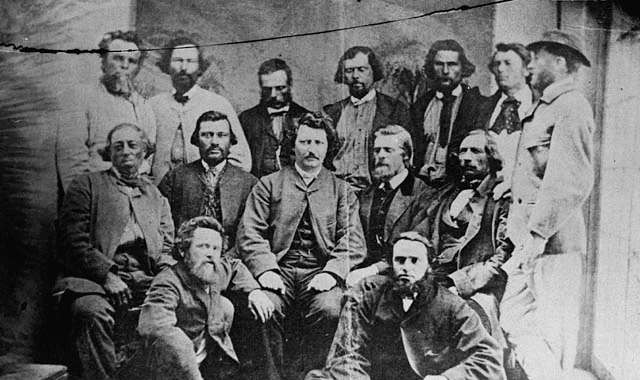
Manitoba’s entry into Confederation was negotiated through Métis political action. The photograph of the provisional government challenges a story in which Canadian expansion simply happened to an unrepresented population.
 Enlarge and examine the picture
Library and Archives Canada · PA-012854 / MIKAN 3194516 · via Wikimedia Commons · Public domain in Canada and the United States · WebP conversion, no enlargement · Source and rights ↗ · Licence terms
Land was not empty
The planned transfer of Hudson’s Bay Company territory to Canada alarmed Métis residents of Red River, who had not consented to the disposal of their homeland. Surveying sharpened the dispute. Resistance to surveyors and the occupation of Upper Fort Garry in 1869 asserted that the people already living there had political rights and a voice in the region’s future.
Negotiation and representation
A provisional government led by Louis Riel negotiated with Canada. In early 1870, the Convention of Forty brought together French- and English-speaking representatives and developed a list of rights. The Manitoba Act became law in May, was approved by the provisional government in June, and took effect in July. This sequence places local deliberation alongside parliamentary legislation.
Examine the people in the photograph
This group portrait is usually associated with the provisional government in 1870. Its familiar description as a photograph of “councillors” is imprecise: the pictured men held offices at different levels, and not all were legislative councillors. Attribution to photographer Joseph Langevin and the precise June date are qualified in the source record. A useful historical picture can still contain uncertainties.
An agreement did not secure safety
The execution of Thomas Scott by a Métis tribunal intensified hostility toward Riel. He fled as the Wolseley expedition approached in August 1870. The Indigenous Peoples Atlas describes violence and intimidation against Métis residents after Canadian troops arrived. Manitoba’s creation therefore should not be presented as the uncomplicated fulfilment of the rights its negotiators sought.