206 BCE–220 CE · Asia · Culture
Han China: cities, households and a connected empire
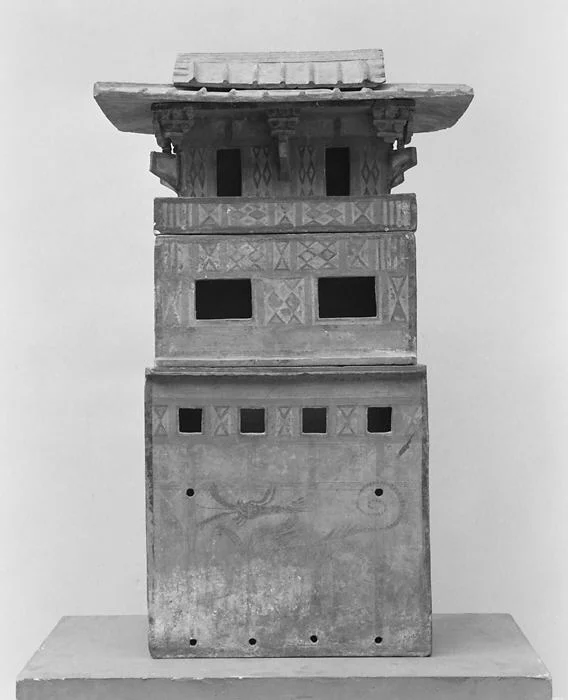
Han history includes administration, writing and long-distance exchange as well as conquest. A pottery house model opens a different view: the buildings and material comforts imagined for life after death.
 Enlarge and examine the picture
The Metropolitan Museum of Art · Rogers Fund, 1951 · 51.127.2a–f · Public domain / CC0 · Resized to WebP · Source and rights ↗ · Licence terms
Two Han periods, two capitals
The Han dynasty followed the Qin and the civil wars that came after it. Western Han rulers governed from Chang’an; Eastern Han rulers later made Luoyang their capital. The conventional span, 206 BCE–220 CE, includes an interruption between these two periods. It should not be read as four centuries of unchanged government.
A house made for a tomb
The pictured Eastern Han object is a multi-part earthenware model with traces of pigment. The museum classifies it as tomb pottery. Roofs and structural forms invite close observation, but the model is not a surviving full-size house, a measured architectural plan or a photograph of an ordinary family. Funerary objects reveal choices about representation as well as building traditions.
Texts, officials and wider horizons
Under Emperor Wu, Confucian writings gained a central role in official education and conduct. Sima Qian’s Historical Records helped shape later historical writing. Han expansion also connected the court with Central Asia, while trade brought goods and crops across long routes. These exchanges involved intermediaries; a map of trade is not automatically a map of direct imperial control.