1520–1566 CE · Middle East · Empire
Ottoman authority on paper: Süleyman’s tughra
A decorated imperial emblem reveals how Ottoman government made authority visible—and the skilled work behind the ruler’s public identity.
 Enlarge and examine the picture
The Metropolitan Museum of Art · 38.149.1 · Rogers Fund, 1938 · Public domain / CC0 · Resized and converted to WebP · Source and rights ↗ · Licence terms
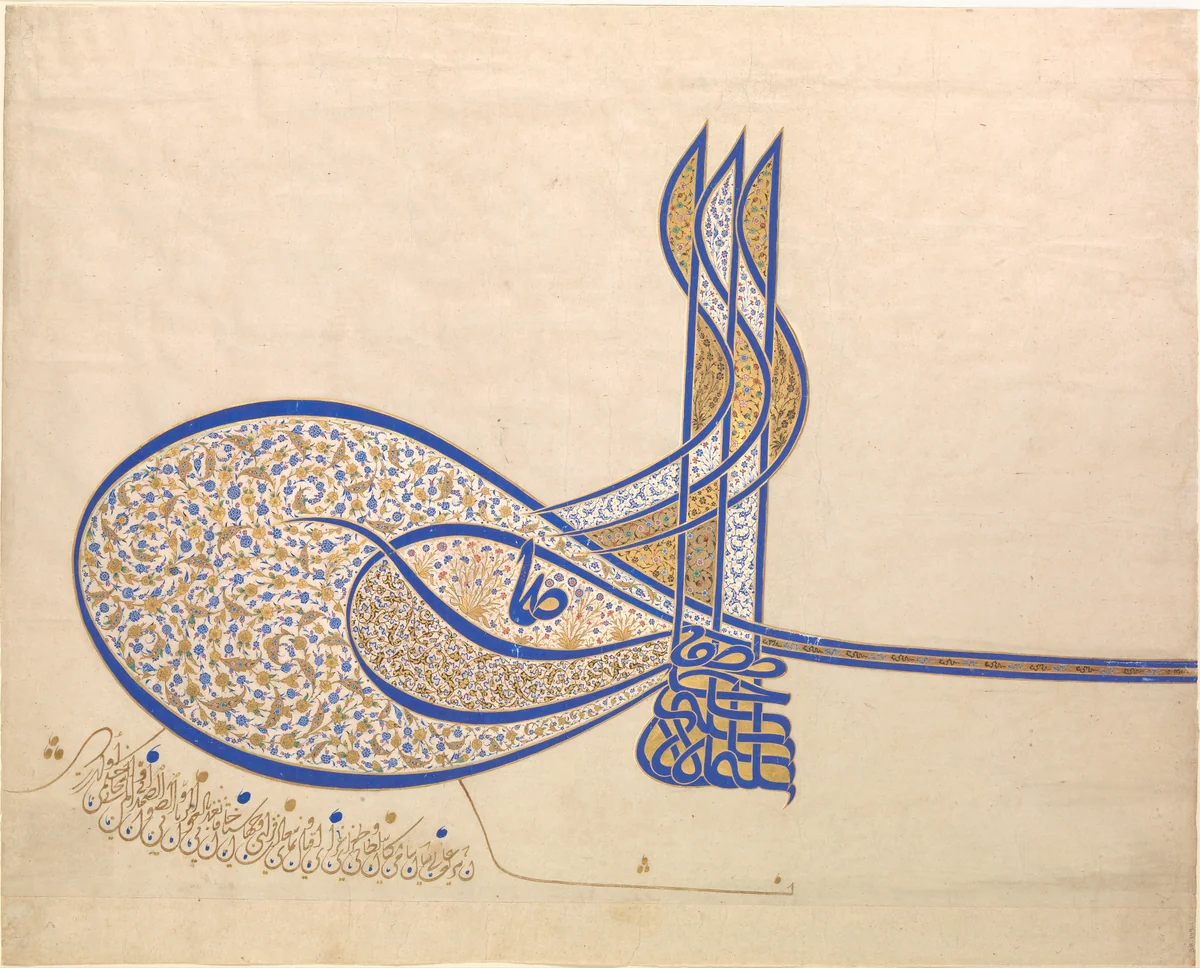
An emblem that authenticated authority
The tughra appeared on decrees, endowment documents, correspondence and coins. Süleyman’s emblem combines his name, his father’s name, a title and a formula of victory. Its elaborate loops and shafts therefore belong to written government, not simply abstract decoration. The pictured example dates to about 1555–60, within his reign of 1520–1566.
The hands behind the ruler’s sign
A designated court artist drew the standard emblem; an illuminator could embellish important documents. Here, gold, colored pigments and flowers enrich the calligraphy. Its complexity also made copying difficult. This division of skilled labor matters: the sheet is not Süleyman’s personal handwriting, and the image should not be presented as a complete surviving decree.
An empire of production centers
Istanbul was not the only place where Ottoman visual culture took shape. Bursa was associated with silk and textiles, Iznik with ceramics, Cairo with carpets and Baghdad with book arts. Imperial patronage connected these centers without eliminating regional variation. Reading an Ottoman object through present-day national borders alone can obscure the networks of makers, patrons and materials that sustained it.
Power represented, not every life recorded
Sinan’s buildings and the religious foundations commissioned by imperial and provincial elites offer other material expressions of this political world. The tughra is a valuable starting point for asking how sovereignty was represented. It is not a substitute for provincial records or accounts of ordinary households. An official image tells us what authority wished to display; its beauty does not establish how fairly that authority was exercised.