750–1258 CE · Middle East · Culture
Abbasid Iraq: cities, skilled craft and learning
Baghdad and Samarra brought political patronage, specialised crafts and intellectual life into new urban settings. Surviving glass and architectural decoration illuminate a history that extends beyond dynastic succession.
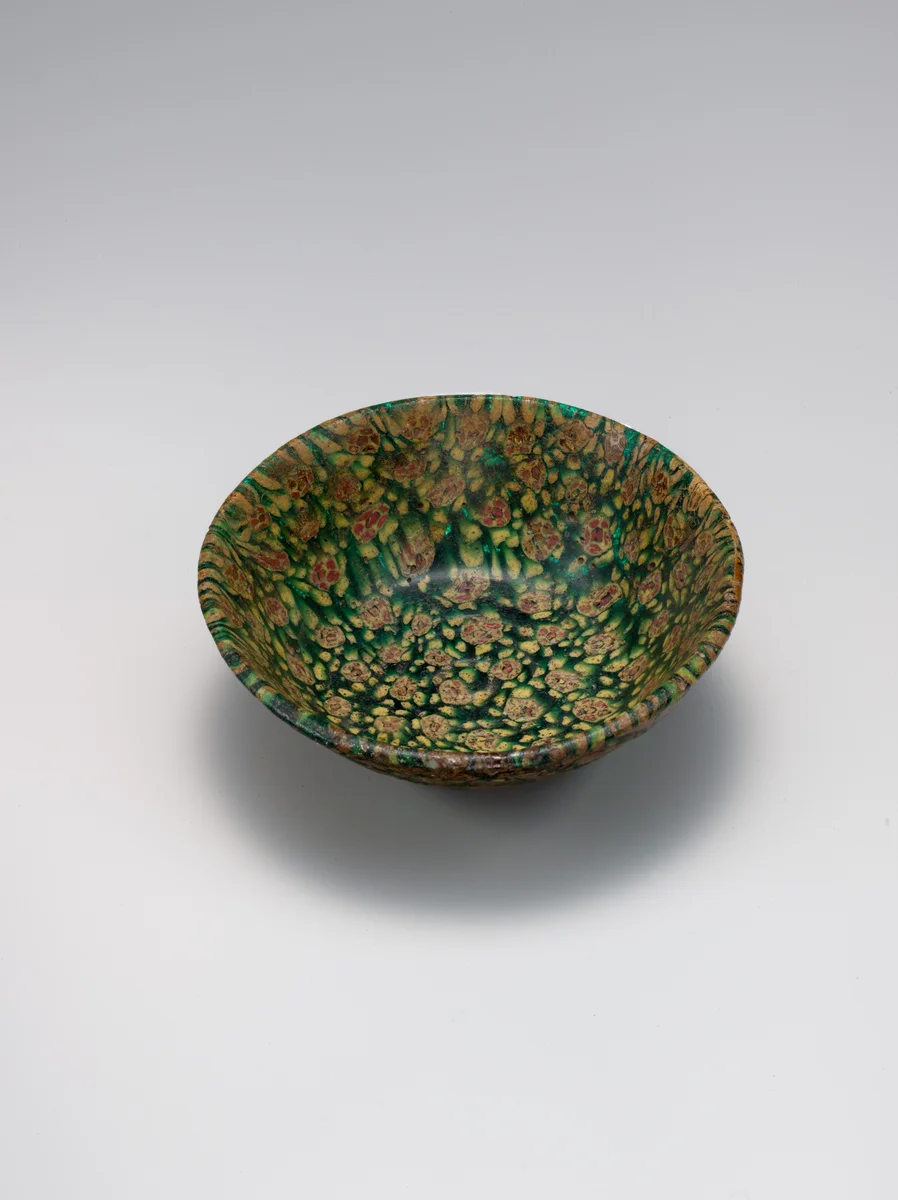 Enlarge and examine the picture
The Metropolitan Museum of Art · Rogers Fund, 2001 · 2001.266 · Public domain / CC0 · Resized and converted to WebP · Source and rights ↗ · Licence terms
New centres in Iraq
The Abbasids replaced the Umayyads in 750. Baghdad, founded in 762, became their capital; Samarra held that role from 836 to 892. These shifts moved the principal imperial centres from Syria to Iraq. They did not make all Islamic societies culturally identical, nor erase the histories of the regions connected with the caliphate.
Examine the glass bowl
The ninth-century bowl pictured here is attributed, with uncertainty, to Iraq. Its coloured mosaic glass was fused, shaped and polished. The Met links the renewed use of this millefiori technique to eighth- or ninth-century Mesopotamia and suggests possible caliphal patronage. That is not proof that this particular vessel belonged to a named ruler.
A shared repertoire, not one material
At Samarra, craftsmen developed abstract ornamental forms in carved architectural surfaces. Related patterns travelled into woodwork, pottery and other media. Lustre-painted ceramics, valued for a metallic-looking sheen, also circulated widely. Such objects reveal technical knowledge and adaptation; a glass bowl and a lustre-painted ceramic bowl were made by different processes.
Institutions changed as political power fragmented
Abbasid authority weakened as other dynasties gained power. Baghdad nevertheless experienced renewed book production and the construction of the Mustansiriyya college in the thirteenth century before the Mongol sack of 1258. This bounded study introduces urban patronage and learning; Islamic legal traditions, translation networks and the many societies outside Iraq need their own accounts.