550–31 BCE · Europe · Culture
Ancient Greek social worlds: vessels, clothing and cultural exchange
Painted pottery and clothing bring Greek history beyond its battlefields. These objects reveal social gatherings, skilled labour and cultural exchange—but not an equal or uniform society.
 Enlarge and examine the picture
The Metropolitan Museum of Art · Fletcher Fund, 1931 · 31.11.11 · Public domain / CC0 · Resized and converted to WebP · Source and rights ↗ · Licence terms
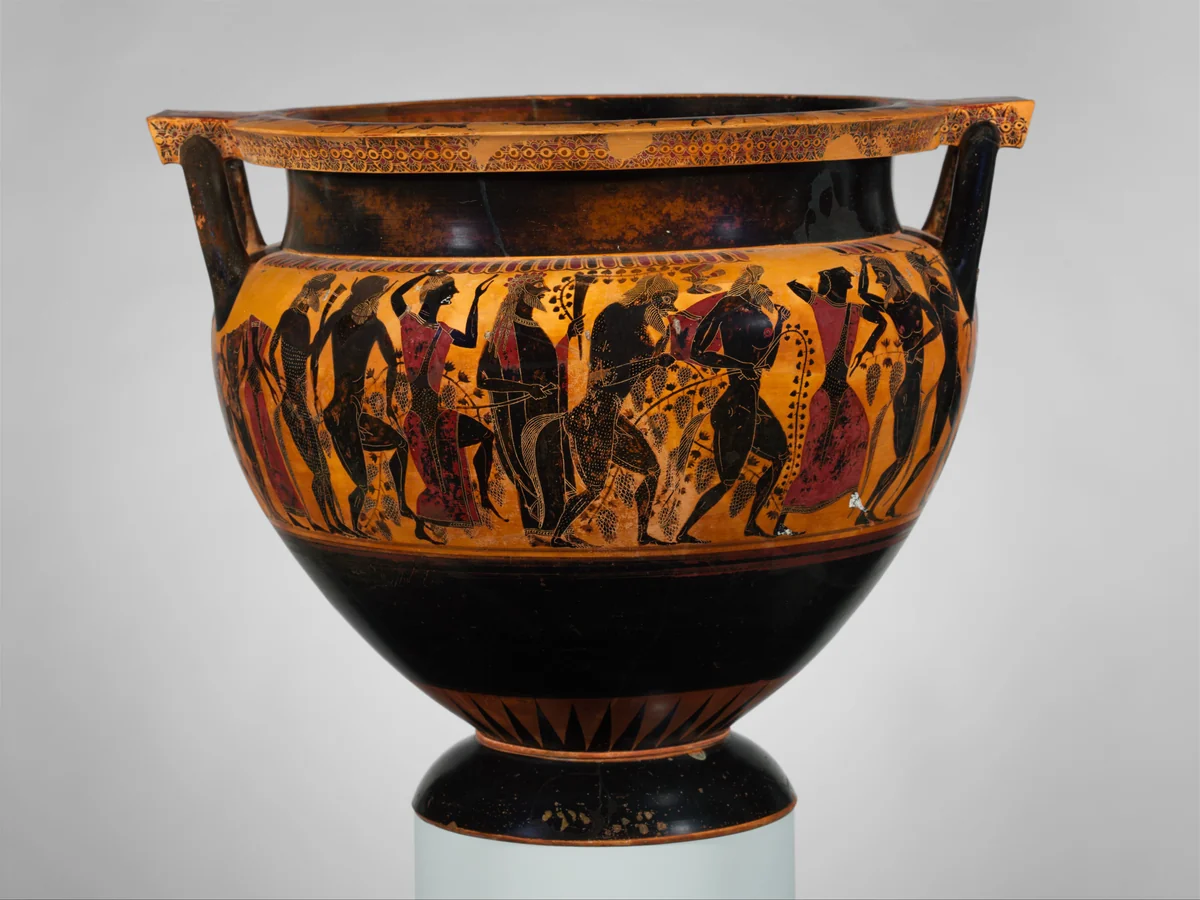
An object used at a gathering
The Attic krater pictured here, attributed to Lydos and dated around 550 BCE, mixed wine with water. Its painted procession is mythological: it shows the return of Hephaistos among Dionysos and his followers, not a photograph-like record of an actual party. Reading an image requires distinguishing the object’s practical use from the story painted upon it.
Whose social life is represented?
The symposium was an elite male gathering involving drinking, conversation, entertainment and social relationships. Its surviving vessels give unusually rich evidence, but they do not represent every household or everyone present on equal terms. Treating this aristocratic practice as the daily life of all Greeks would erase differences of gender and status.
Colour, textiles and household work
Ancient Greek dress was not uniformly white. Vase painting and surviving traces of colour show patterned and brightly coloured fabrics. Tunics and cloaks used folded, pinned or sewn cloth; garments could be adapted for different activities. Much clothing was made at home. Textile production belongs in the historical account alongside the finished objects that museums preserve.
After Alexander: several connected Greek worlds
Following Alexander’s death in 323 BCE, successor dynasties ruled in Macedonia, Egypt and western Asia, while city-state leagues also operated. Royal patronage, commercial exchange and the mobility of craftspeople reshaped art. Alexandria and Pergamon became important centres of collecting and learning. The conventional end of the Hellenistic period is associated with Actium in 31 BCE, not with the disappearance of Greek language or culture.