794–1185 CE · Asia · Culture
Heian Japan: court writing, belief and artistic worlds
Before the familiar image of samurai rule, Heian Japan developed influential literary and religious traditions. Court diaries, narrative fiction and Buddhist sculpture offer different kinds of evidence, not one uniform picture of society.
 Enlarge and examine the picture
The Metropolitan Museum of Art · The Harry G. C. Packard Collection of Asian Art, 1975 · 1975.268.163 · Public domain / CC0 · Resized to WebP · Source and rights ↗ · Licence terms
A capital and a powerful court
Heiankyō, now Kyoto, became the capital in 794. The Fujiwara family built influence through marriage into the imperial house. Court culture adapted continental traditions while cultivating kana writing, waka poetry and Japanese subjects in painting. Continued travel and religious exchange mean this was not an age of complete isolation.
Women wrote enduring accounts and imagined lives
Murasaki Shikibu’s Tale of Genji and Sei Shōnagon’s Pillow Book are central to the period’s literary legacy. They illuminate courtly sensibilities, language and relationships, but their genres differ: a fictional narrative is not a diary of verified events. Both provide views associated with a privileged social setting, not a complete record of rural life.
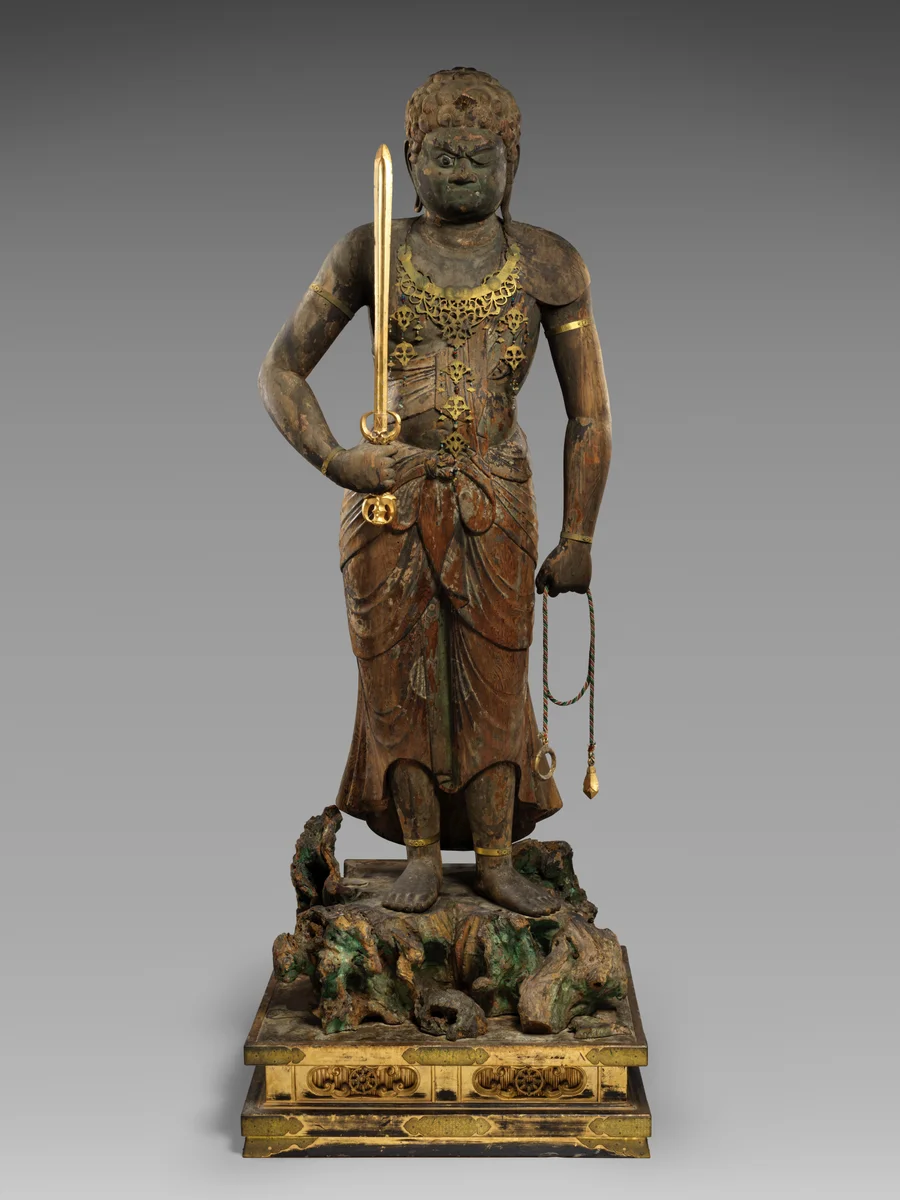
Look at the protective deity
The twelfth-century Fudō Myōō sculpture shown here was formerly a central image at Kuhonji Temple northwest of Kyoto. Its body was assembled from six hollowed wooden pieces. In this Buddhist imagery, the sword cuts through ignorance and the lasso restrains obstacles to enlightenment. The fierce expression belongs to a religious protector, not a portrait of a warrior.
Beyond an elegant court
By the later twelfth century, powerful provincial warriors increasingly displaced aristocratic control of government. The conventional end date of 1185 marks a political transition, not the disappearance of Heian literature or religious art. Court-focused evidence needs to be read alongside future studies of landholding, work and provincial communities.