1904–1989 CE · Europe · Rights
Sámi organizing: language, land and political representation
Sámi history crosses national borders. Women’s organizing, campaigns over land and education, and the Alta conflict connect cultural survival with demands for political representation.
 Enlarge and examine the picture
Hilfling-Rasmussen / NTNU University Library, HI-v-11085_01 · CC BY-SA 4.0 · Resized and converted to WebP; derivative under the same licence · Source and rights ↗ · Licence terms
A people across borders, not a single language
Sámi traditional homelands extend across parts of Norway, Sweden, Finland and Russia. The names Sápmi, Sábme and Saepmie reflect different Sámi languages, not separate nation-states. State borders cut across traditional language areas. A history organized only by modern countries therefore misses important connections. This study follows selected organizing in Norway and Sweden; it does not represent every Sámi community or reduce Sámi identity to one occupation.
Elsa Laula and women’s political organizing
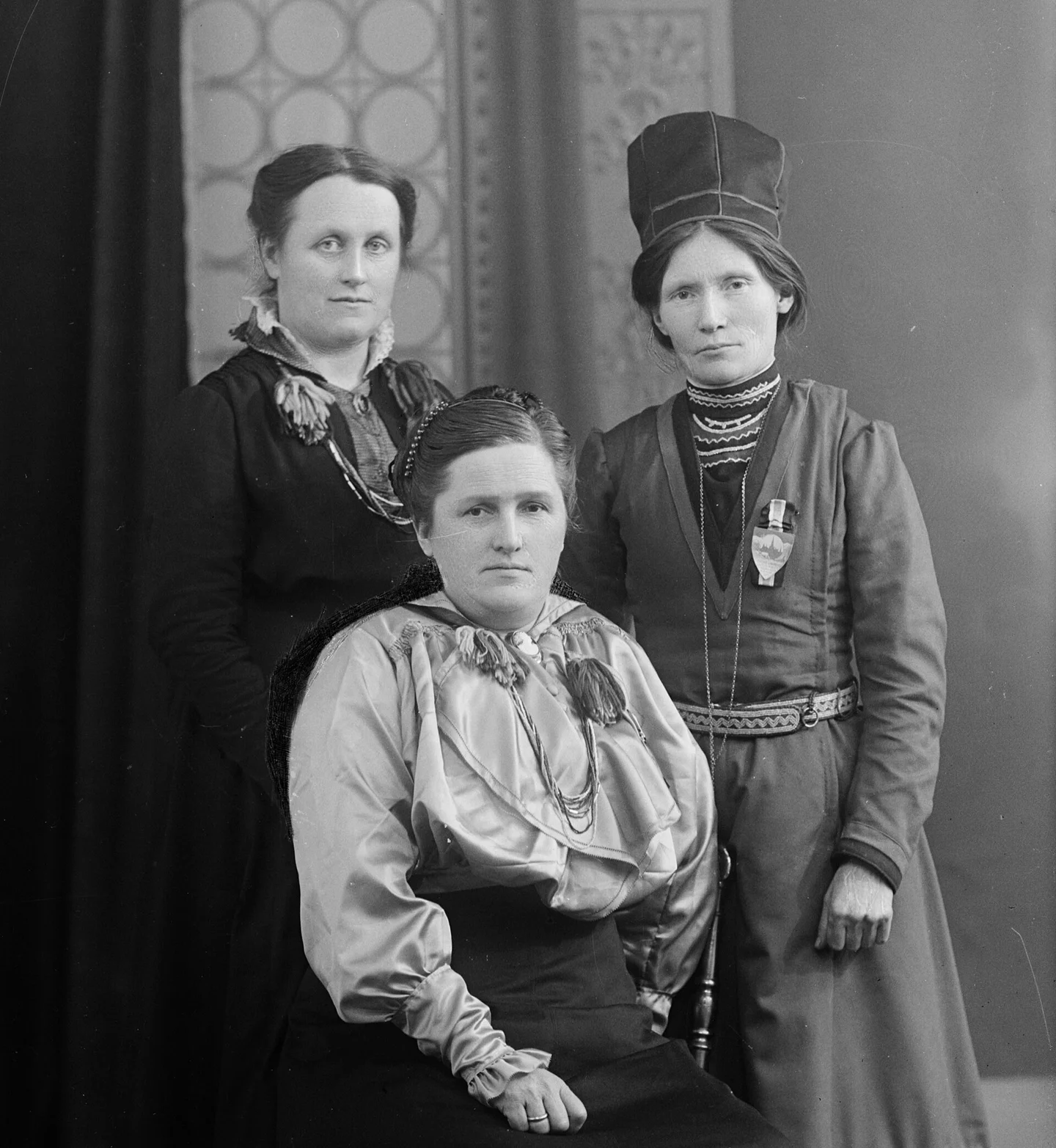
Elsa Laula Renberg’s 1904 pamphlet Inför Lif eller Död? challenged threats to Sámi rights in land, water and education. She helped establish an association in Sweden that year and a Sámi women’s association at Brurskanken in 1910. She was a central organizer of the congress held in Trondheim, or Tråante, on 6–9 February 1917. The portrait shown here dates from March: it is not an image of the congress proceedings.
Alta: land use became a national confrontation
In 1978 Norway’s parliament authorized the Alta–Kautokeino hydroelectric development. Opposition brought Sámi rights and environmental concerns into a highly visible conflict: hunger strikes in 1979 were followed by a major police operation against protesters in 1981. The Museum of Justice presents Alta as a turning point in public recognition of Sámi rights after a long history of assimilation. The dispute also helped prompt the establishment of a Sámi rights committee.
Representation without erasing diversity
Norway’s Sámi Parliament opened on 9 October 1989. It is an elected body concerned with Sámi language, culture and society, and with strengthening self-determination within its institutional framework. It is not a government for all Sámi across four countries. Its establishment marks a particular political achievement, not the end of struggles over land or language. Earlier histories, differing livelihoods and the experiences of Sámi in Finland and Russia need their own sustained treatment.