1814–1919 CE · Europe · Rights
Norway: constitution, union and the expansion of democracy
Norway’s 1814 constitution, its union with Sweden and independence in 1905 were different milestones. Political participation widened through further struggles rather than arriving fully formed at Eidsvoll.
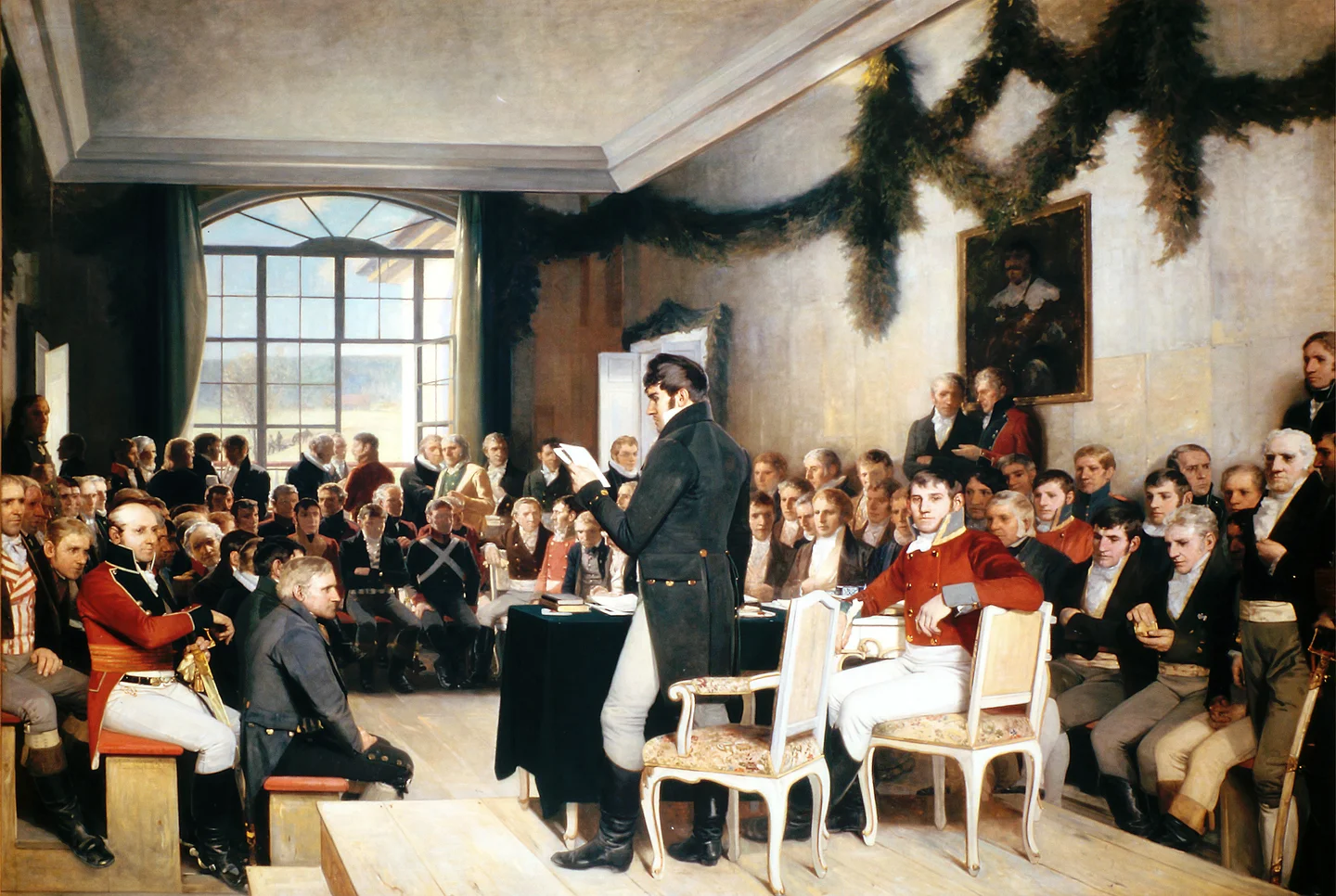 Enlarge and examine the picture
Oscar Wergeland (1844–1910) / Wikimedia Commons · Public-domain artwork and faithful reproduction · Resized and converted to WebP · Source and rights ↗ · Licence terms
1814: a constitution amid international upheaval
The National Assembly met at Eidsvoll in April 1814. On 17 May it adopted a constitution and elected Christian Frederik king. Independence did not last: November constitutional changes enabled union with Sweden while preserving substantial Norwegian self-government.
Parliamentary government was another struggle
Constitutional government did not immediately mean parliamentary accountability. In 1884 the Selmer government was impeached, and Johan Sverdrup formed a government supported by the parliamentary majority—a further transformation after Eidsvoll.
1905: the consular dispute and independence
A dispute over separate Norwegian consulates brought the union crisis to a head. On 7 June 1905 the Storting declared that the king had ceased to function as Norwegian monarch. A referendum endorsed dissolution; Sweden recognized independence on 26 October. Prince Carl of Denmark became King Haakon VII.
Who could vote—and what the painting represents
Male suffrage expanded in 1898 and women obtained the parliamentary vote in 1913; poor-relief exclusions survived until 1919. Oscar Wergeland painted the Eidsvoll assembly in 1885, seventy-one years after it met. This is a later historical interpretation, not an eyewitness image.