1560–1638 CE · Europe · Faith
Scotland’s Reformation: Knox, confession and an unfinished settlement
Explore the 1560 settlement and its later legacy through confessions, disciplinary proposals and a carefully identified 1638 printed document.
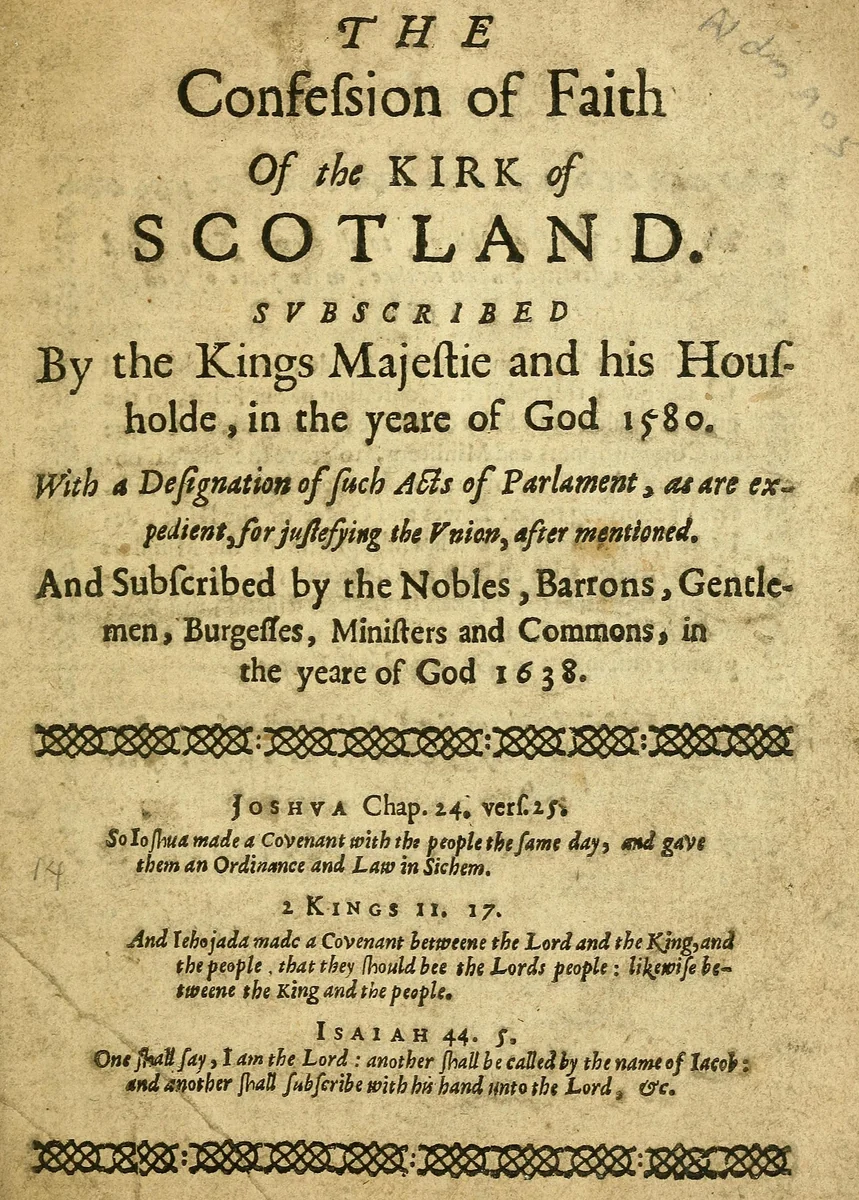 Enlarge and examine the picture
Church of Scotland / Princeton Theological Seminary Library, via Internet Archive and Wikimedia Commons · Public domain · Resized without cropping and converted to WebP · Source and rights ↗ · Licence terms
Reform across borders
John Knox’s Scottish work belonged to an international movement. His experience in England and Geneva connected him with debates about preaching, worship and church government beyond Scotland. Yet Scotland was not simply Geneva reproduced elsewhere. Parliament, nobles, ministers and congregations helped determine the settlement’s direction. The Church of Scotland’s institutional history identifies Calvin’s influence while showing how Scottish church government continued developing long after the decisive legislation of 1560.
What happened in 1560
Knox and five other ministers prepared the Scots Confession, which Parliament approved in August 1560. Its twenty-five chapters addressed Scripture, the church, sacraments and civil authority. Other parliamentary measures rejected papal jurisdiction and prohibited the Mass. These changes established a Protestant religious settlement, but did not grant equal public freedom to Catholics. Reformation here describes a consequential redistribution of religious authority, not the immediate arrival of modern toleration.
A programme for church life
The First Book of Discipline offered a programme covering doctrine, sacraments, ministerial appointments, financial support and ecclesiastical discipline. Its prefatory explanation reveals reformers trying to turn convictions into an operating institution. The text records proposals and aspirations, not proof that every provision was implemented successfully. Readers should distinguish the authors’ desired order from conditions achieved in individual parishes. Organizing ministry was as important to this project as celebrated sermons or confrontations.
A settlement still developing
The Church of Scotland dates statutory recognition of its complete Presbyterian system of church courts to 1592, not 1560. Later conflicts produced further confessional documents and covenants. The illustrated publication dates from 1638 and reuses the King’s Confession of 1580–81; it is not the original Scots Confession of 1560. Its title page shows successive generations invoking declarations of faith in disputes over authority. The original archive catalogue establishes this distinction despite the image’s abbreviated online filename.
Knox through Wylie’s lens
J. A. Wylie’s nineteenth-century History of Protestantism treats Scotland’s Reformation as spiritual liberation with far-reaching national consequences. This is an influential classical Protestant interpretation, not contemporary, disinterested description. Knox’s own history is likewise testimony from a committed participant. Such writings illuminate convictions when their standpoint is explicit. Comparing them with the confession, disciplinary proposals and institutional chronology prevents later celebrations from obscuring coercion, political negotiation or the unfinished nature of the settlement.