1392–1600 CE · Asia · Culture
Early Joseon Korea: writing, belief and the potter’s art
Early Joseon rulers and scholars reshaped institutions and cultural patronage. A new alphabet and inventive ceramics belong to this history alongside the court’s Neo-Confucian programme.
 Enlarge and examine the picture
The Metropolitan Museum of Art · Rogers Fund, 1916 · 16.122.1 · Public domain / CC0 · Resized to WebP · Source and rights ↗ · Licence terms
A new dynasty and competing traditions
The Joseon dynasty began in 1392. Its rulers promoted Neo-Confucian ideals in education, government and social relations. Buddhism lost official support, yet private devotion and Buddhist artistic production continued. State ideology therefore does not describe every person’s beliefs or erase the traditions that preceded it.
An alphabet and its explanation
King Sejong completed the development of the Korean alphabet in 1443; the Hunminjeongum publication of 1446 announced it and included scholarly explanations and examples. Today the alphabet is commonly called Hangul or Hangeul. This history is distinct from the earlier Korean development of movable metal type: a writing system and a printing technology answer different needs.
Peonies cut into white slip
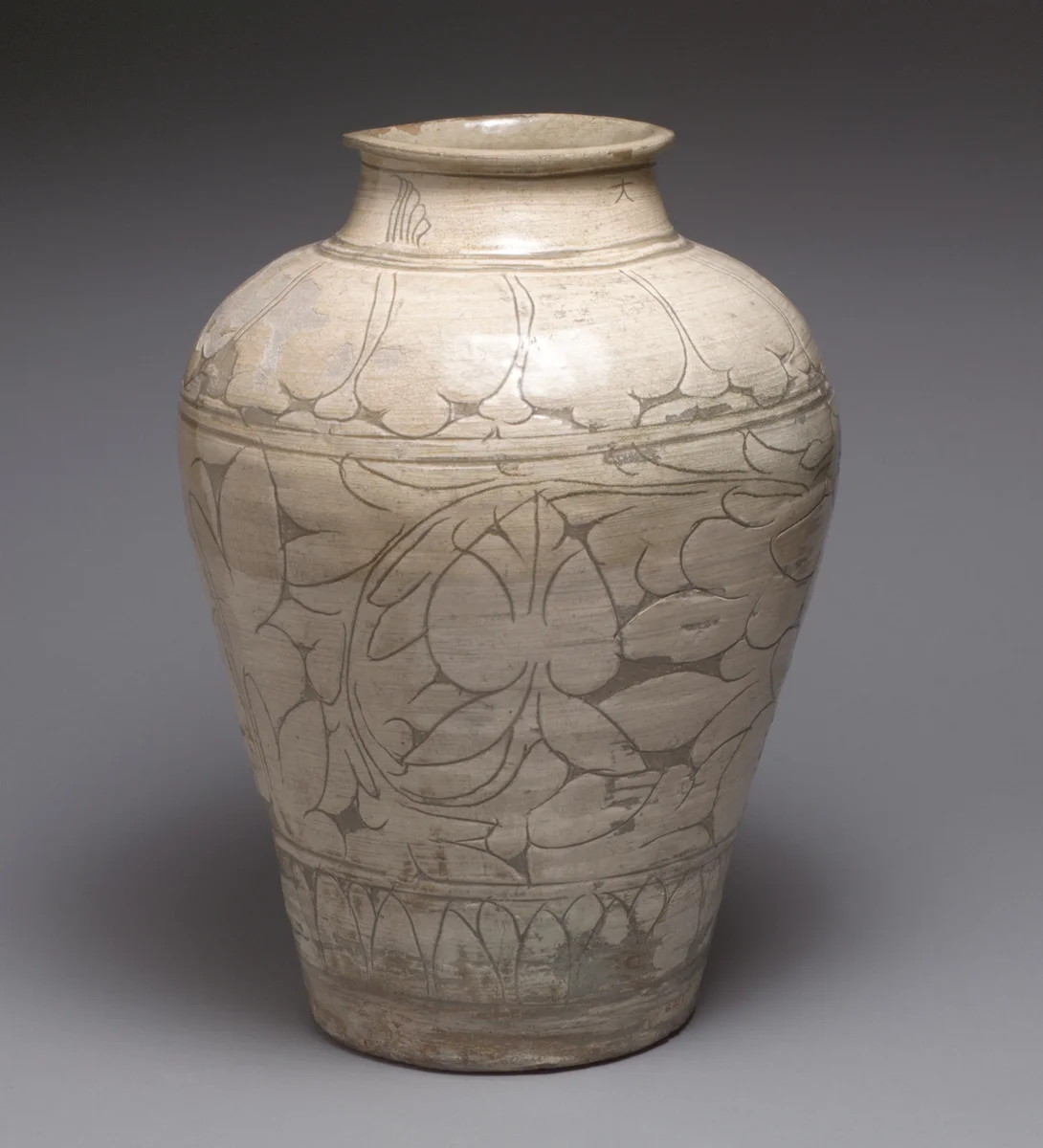
The pictured late-fifteenth-century buncheong jar has peony flowers and leaves cut through a white surface coating. Its incised and carved decoration is associated with production in Jeolla Province. The peony carried associations of wealth and prestige. This surviving vessel lets readers examine material technique rather than reducing Korean culture to a list of kings.
More than one visual language
Court and literati patronage also favoured white porcelain and landscape painting. Artists transformed inherited themes rather than simply reproducing Chinese models. The bold decoration of buncheong and the restraint associated with white porcelain show why one object cannot stand for every taste, workshop or household. Later Joseon social change and the nineteenth-century crisis remain separate chapters.