1566–1581 CE · Europe · Faith
The Netherlands: petition, union and withdrawal of allegiance
Petitions, provincial agreements and the Act of Abjuration record changing answers to royal authority and religious coercion. Their differences resist a story of one united nation declaring a modern republic in a single moment.
 Enlarge and examine the picture
University Library Utrecht via Wikimedia Commons · Public domain · Native dimensions and complete supplied extract retained; WebP encoding · Source and rights ↗ · Licence terms
Loyal opposition and the language of allegiance
The documents of the revolt do not begin with a settled independent nation speaking in one voice. A short remonstrance dated 5 April 1566, preserved on Leiden University Library’s Dutch Revolt site, professes service to the king and the common welfare. It denies charges of rebellion, seeking another lord and making foreign alliances, and asks that accusers be identified. These three paragraphs are a defensive statement. They cannot by themselves supply every demand associated with the famous petition of the nobles. The distinction matters because familiar document titles can conceal differences between the surviving texts presented under them. Reading the actual words, rather than a later shorthand for the event, reveals people arguing about what loyal service required. Subsequent documents would change the terms of allegiance. That later outcome should not be read backward as the signatories’ already completed programme in 1566.
An association against religious coercion
The association text known as the Compromise of the Nobles provides a fuller statement of opposition. Its signatories challenge inquisitorial enforcement and religious placards, invoke privileges and promise mutual protection. They also profess service to the king and disavow sedition. Opposition to coercion therefore appears here alongside claims of loyalty, rather than simply replacing them. The text’s allegations against advisers and warnings of devastation belong to the signatories’ case; they do not independently establish every opponent’s motive or every predicted consequence. The Leiden transcription follows a later printed transmission in Pieter Bor’s history, not an original sheet signed before the reader’s eyes. Its year-only heading does not establish an exact signing day. Keeping those limits visible allows the pledge to explain a political association without making it a complete account of the revolt. It shows how rights, religion and allegiance could be joined in a demand for change within an existing political order.
Ghent: a provisional and unequal settlement
The Pacification of Ghent of 8 November 1576 sought mutual peace and amnesty alongside the expulsion of Spanish and other foreign soldiers. Its opening provisions also assigned questions of religious practice to a future States General. Agreement on these objectives did not mean agreement on one religious settlement everywhere. Clauses governing movement and commerce did not authorize attacks on Catholic practice outside the territories specially addressed by the agreement. The suspension of religious penal measures also operated under conditions while further arrangements remained unsettled. The document thus combined immediate cooperation with postponed decisions. Describing it as universal freedom of worship would obscure the territorial distinctions on which that cooperation rested. Nor does a negotiated text prove that its terms were successfully observed. Its value is more precise: it records an attempt to hold partners together despite different religious positions, making the unsettled character of the alliance part of the evidence rather than an inconvenience to be ignored.
Utrecht: common defence and retained privileges
The Union of Utrecht in January 1579 connected common defence with retained provincial privileges. Articles I–III and IX set out commitments and decision rules; the member territories retained their distinct identities. The archival record also preserves different witnesses, amendments and later accessions. Not every province joined at one instant. The Leiden page’s heading and its February clarification give different January dates, so the month is used here without silently harmonizing them. A union document describes obligations among participants, not proof that a fully formed nation had already emerged.
Conscience and public worship were different questions
Article XIII left Holland and Zeeland their arrangements and permitted differing provincial religious settlements while protecting individual conscience against religious investigation and persecution. The clarification of 1 February 1579 expressly allowed membership where Catholic worship alone was publicly practised, without interference by other members on that account. Protection of conscience therefore did not establish equal public worship for every confession. These clauses record an agreed distinction; they do not demonstrate uniform implementation. The treaty’s own qualifications must remain visible when its language is compared with later ideas of religious liberty.
Abjuration: ending Philip’s lordship, arranging its replacement
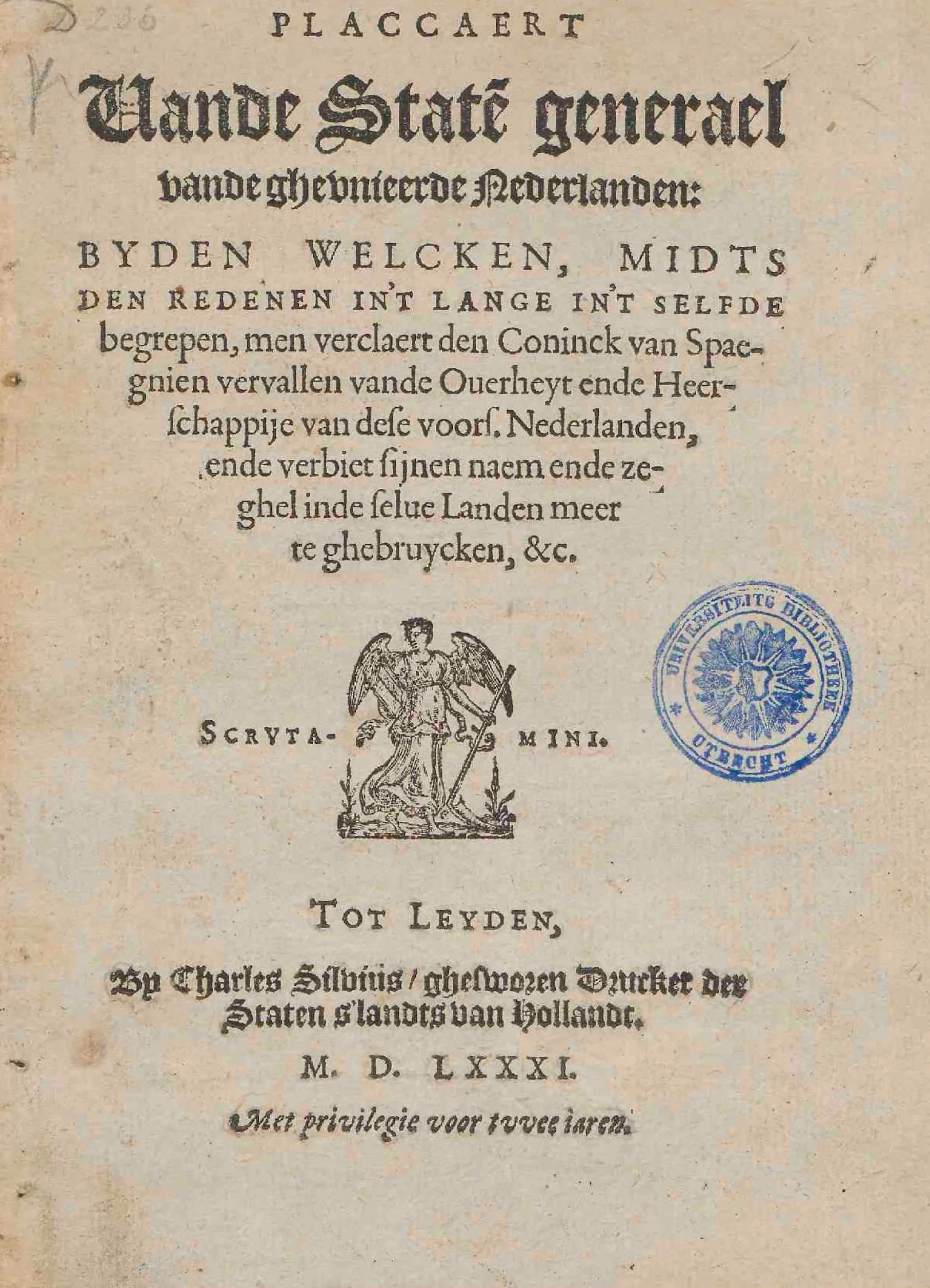
The Act of Abjuration of 26 July 1581 opens with an argument about a prince’s obligation to protect his subjects and the consequences of tyranny. Its accusations against Philip belong to the States General’s stated justification. The operative declaration ends his lordship and releases subjects from their oaths. This was a consequential withdrawal of allegiance, but the clauses that follow prevent it from being treated as an instant modern republican constitution. They acknowledge arrangements with Anjou and provisional administration, including distinct arrangements for Holland and Zeeland. Replacing royal names, seals, coinage and oaths made the change a practical problem of government as well as an argument about authority. The printed title page shown here belongs to the circulation of that act. It is not the manuscript minute in which the decision was drafted. Reading beyond the opening declaration reveals replacement authority still being organized, rather than a finished political system appearing at one stroke.
Later Protestant histories and national memory
J. A. Wylie’s History of Protestantism presents Utrecht as a foundation for later national development and places the struggle within a confessional account. That retrospective interpretation should be distinguished from the union’s own provisions. Ellen G. White’s Great Controversy likewise places persecution and resistance within a theological history, emphasizing martyr witness and William of Orange. Her discussion explicitly cites Wylie, so these accounts cannot be counted as independent contemporary confirmations of the same events. Their significance lies partly in the later Protestant memory they helped shape. Reading them beside the agreements reveals changes of scale and purpose: a treaty negotiates obligations among particular partners, whereas a later history can organize events into a national or religious trajectory. Neither shared Protestant identity nor a narrative of eventual independence should obscure the documents’ provincial differences.