1618–1648 CE · Europe · War
The Thirty Years’ War and the Peace of Westphalia
A revolt in Bohemia widened into overlapping wars. Legal texts, a Swabian chronicle and a period print connect contested religious privileges, civilian survival and the negotiated settlement of 1648.
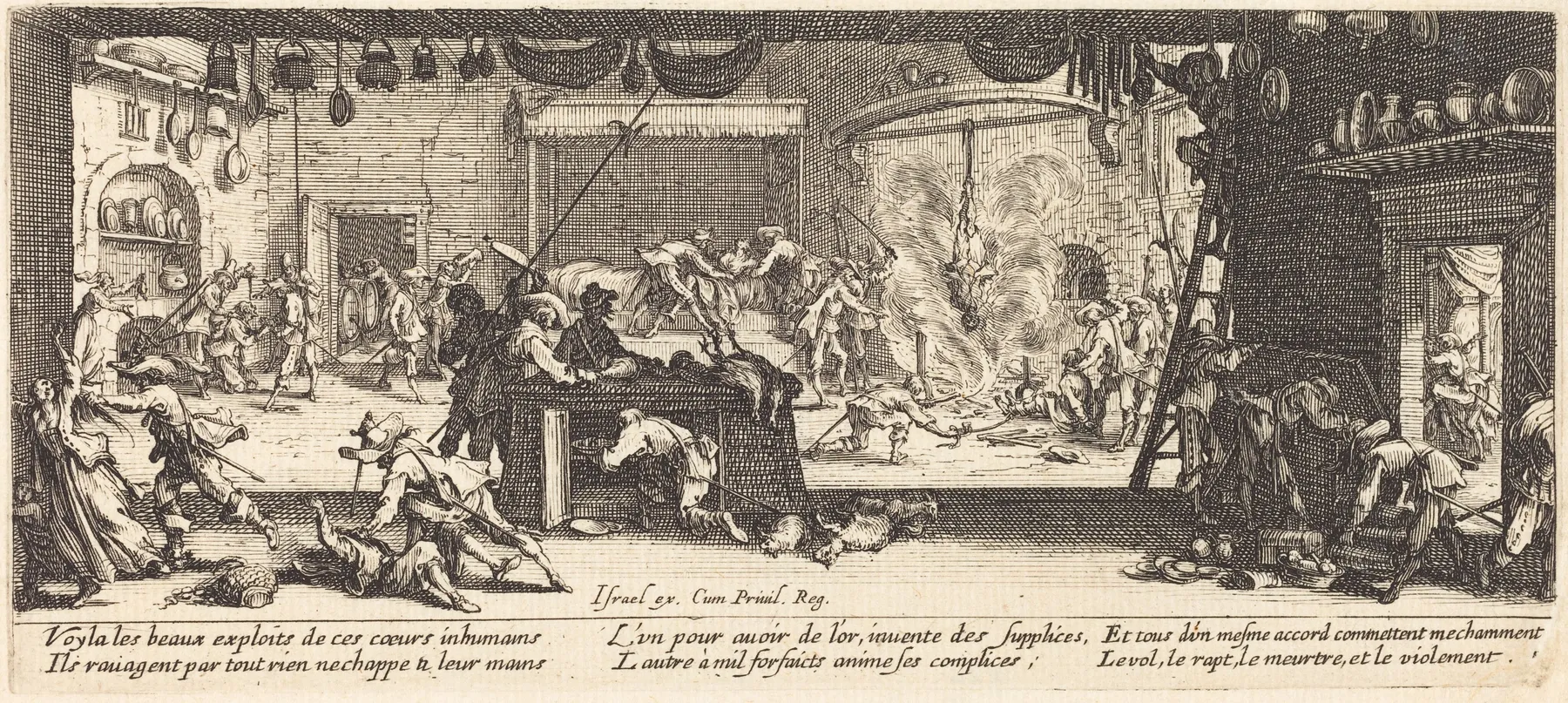 Enlarge and examine the picture
Rosenwald Collection · 1943.3.2218 · Courtesy National Gallery of Art, Washington · Public domain / CC0 · Full supplied image retained; proportionally reduced and encoded as WebP · Source and rights ↗ · Licence terms
A contested peace and a window in Prague
Bohemia’s religious settlement rested on specific legal promises. Rudolf II’s Letter of Majesty of 1609 protected the united Utraquist estates and their subjects who professed the Bohemian Confession, alongside Catholic religious practice. By May 1618, the meaning and observance of those guarantees were fiercely disputed. A Catholic-aligned account describes nobles confronting royal regents at Prague Castle on 23 May. Accusations about coerced religion and displaced pastors met denials and competing interpretations of the royal grant. The confrontation ended with two regents and a secretary being thrown from a window. The account preserves an argument about law and authority as well as violence. Its partisan voice requires attention; it does not supply a neutral verdict on each accusation.
Victory turned into a religious settlement
Imperial and Catholic victories changed what could be demanded. Christian IV participated in the Danish–Lower Saxon phase of 1625–1629 as commander of the Lower Saxon imperial circle. His opponents’ military success preceded Ferdinand II’s Edict of Restitution of March 1629. The edict defended a restrictive Catholic interpretation of the Religious Peace of Augsburg. It demanded the recovery of confiscated ecclesiastical holdings and ordered imperial commissioners to secure their restitution. Bishoprics, monasteries and their revenues were consequently questions of political power as well as worship. The text asserted an enforceable imperial settlement; issuing it did not establish that every ordered transfer occurred. Its commands reveal the ambitions attached to victory.
A war wider than one confession
Swedish intervention in 1630 opened another phase. From 1635, the conventional French–Swedish phase places Catholic France alongside Sweden against Habsburg power. This alignment resists a simple division of every combatant into two religious camps. Peace also meant different things in different places. Hans Heberle’s chronicle describes Ulm’s reception of the Peace of Prague in 1635: religious and civic liberties were celebrated with services, bells and artillery. He identifies newsletter reading within this account. This records local reception, rather than complete treaty terms or an end to the wider war.
Households between soldiers and scarcity
Heberle, a cobbler and small farmer near Ulm, placed household needs beside military events. He recalled fleeing into woods with his wife and children, lacking food and then seeking refuge elsewhere. Cavalry plunder interrupted that attempt at safety too. His account of 1635 connects high prices, hunger and plague, while distinguishing some purchases he personally made from information obtained through others. This situated chronicle cannot represent every community’s experience. Jacques Callot’s etching Plundering a Large Farmhouse, about 1633, offers a different source: a composed scene of soldiers, occupants, animals and household goods. The period print represents military plunder; it does not identify Heberle’s home or document a named raid.
Negotiating peace in two cities
Agreement in October 1648 joined negotiations at Osnabrück and Münster. The former treaty named Emperor Ferdinand III, Queen Christina of Sweden and their allies; the Franco-Imperial treaty named the emperor, Louis XIV and their allies. The settlement addressed the Empire’s political order as well as religion. Article VIII confirmed the estates’ rights and participation in imperial decisions. It permitted alliances, including foreign ones, subject to obligations toward the emperor, Empire and public peace. This was a constitutional arrangement within the Empire, rather than a simple conversion of its territories into independent nation-states.
Protected confessions and the limits of toleration
Article V used 1 January 1624 as a benchmark for specified ecclesiastical possessions and religious arrangements. Its protections included private household worship for specified dissenting subjects. Article VII extended the settlement’s benefits to the Reformed confession alongside Catholics and adherents of the Augsburg Confession. These were substantial, defined protections, not recognition of every belief. The same text retained confessional restrictions, while Article V still addressed emigration and property rights. Provisions concerning Habsburg hereditary subjects also qualified restoration. Reading the clauses together avoids turning a negotiated settlement into a modern declaration of universal religious liberty.
Wylie’s Protestant reading and the work after peace
Writing in the nineteenth century, J. A. Wylie interpreted Gustavus Adolphus’s campaigns as liberation from Catholic and imperial domination. He treated Westphalia’s extension of toleration as the delayed achievement of that mission. His account gives Protestant emancipation a providential shape. That is a later interpretation, rather than another contemporary witness to the negotiations. The institutional history emphasizes a different distinction: agreement could settle political and religious disputes without lifting the burdens already imposed on communities. Legal terms, local testimony and later narratives therefore answer different questions. Their comparison keeps the achievement of peace connected to the difficult conditions it inherited.