1523–1556 CE · Europe · Faith
Women, schools and printed arguments
Selected German-speaking cases connect women’s religious arguments, civic proposals for schooling and the material lives of pamphlets. They reveal specific acts of participation rather than a uniform transformation of everyday life.
 Enlarge and examine the picture
Wellcome Collection ·34964i · Public Domain Mark · Full supplied sheet retained; proportionally reduced and encoded as WebP · Source and rights ↗ · Licence terms
A woman challenges a university
On 20 September 1523, Argula von Grumbach addressed a letter to the University of Ingolstadt. A Bavarian noblewoman with an education unavailable to many women, she challenged its treatment of a student associated with Lutheran teaching. Her protest reached readers in a pamphlet printed at Nuremberg by Friedrich Peypus. Her argument crossed the university’s academic boundaries. Argula’s intervention joined scriptural reasoning to the opportunities of print. It demonstrates what this particular educated woman undertook, without making her experience a measure of all women’s literacy or access to religious debate.
Zell explains her marriage
In 1524, Katharina Zell defended her marriage to a Strasbourg pastor. She explained her decision as an action intended to encourage other Christians. Marriage, in her account, belonged to the practice of faith, rather than remaining merely a private arrangement. She argued from Scripture that clerical marriage was permitted, challenging the prohibition defended by church authorities. Zell spoke as a participant in the controversy, giving her own account of a consequential decision.
A household becomes a public controversy
Zell also answered accusations circulating about the marriage and affirmed her loyalty within it. She denied reports that the couple had separated and described their union as service undertaken together before God. She presented her decision to support her husband as a commitment involving her honor and life, and expressed readiness to endure hostility alongside him. Such assertions made the household part of a public religious argument. They remain her account of disputed circumstances, rather than independent confirmation of every domestic detail.
A call to city councils
In his 1524 appeal to German city councils, Luther urged civic authorities to support schools. His proposals included instruction for boys and girls and assigned towns responsibility for the education of their young people. He emphasized capable teachers, languages and historical learning, and urged the preservation of useful books in libraries. Schooling consequently appeared as an undertaking requiring public decisions, people and material resources. Such proposals offered a programme rather than an account of attendance. Including girls in that programme did not establish equal curricula, while recommending schools did not demonstrate that every community immediately possessed teachers, buildings or pupils. The appeal made education a practical question for civic government.
Printed arguments become material collections
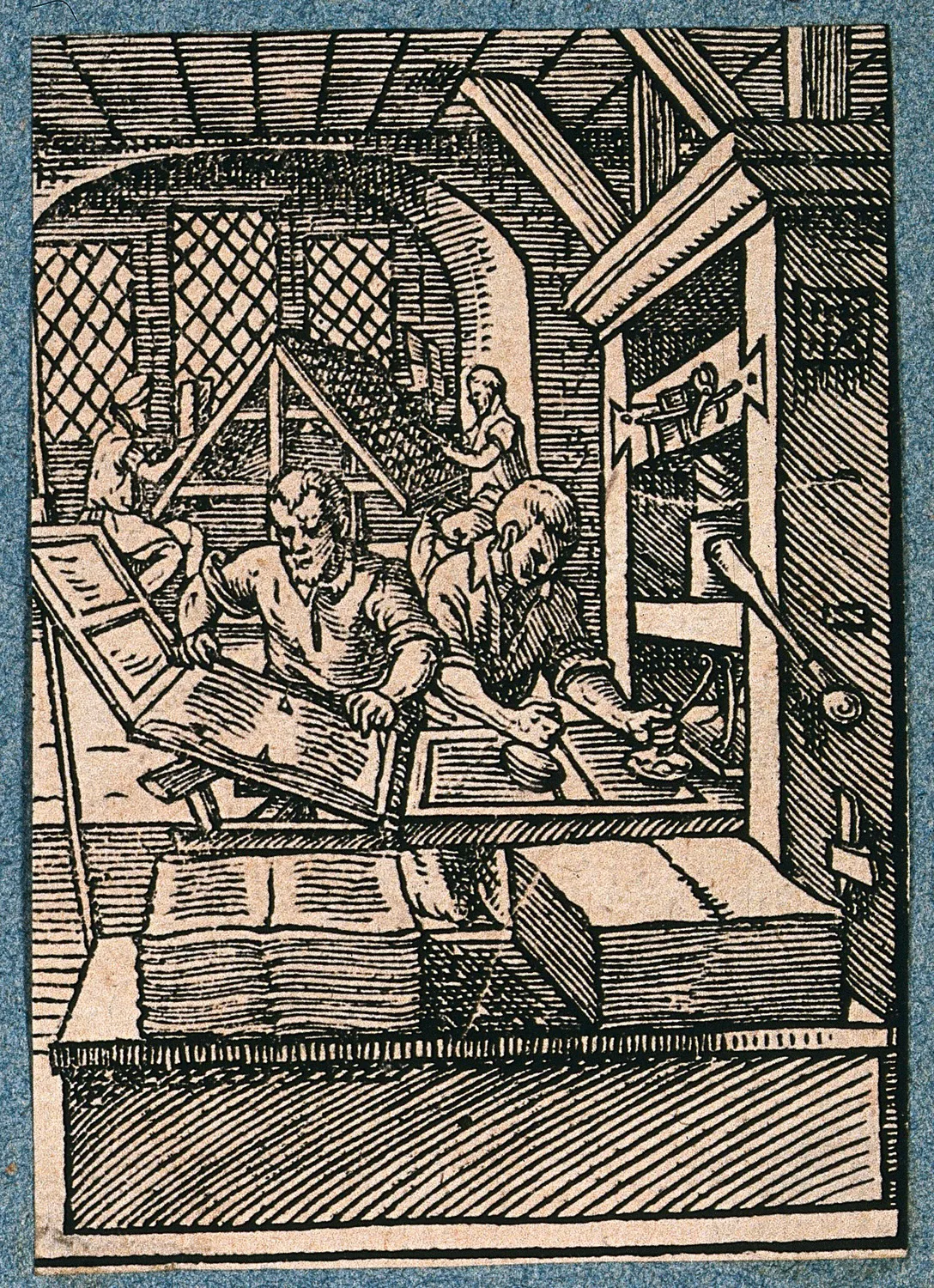
Individual pamphlets acquired further lives through collection and binding. Bridwell Library’s copy of Argula’s university protest survives with twenty-four other Reformation-era pamphlets dating from 1521 to 1556. Signatures and comments connect parts of the collection with particular readers, while its later binding is associated with Simon Gerengel. Another catalogued Argula pamphlet, printed at Bamberg in 1523, addressed Christian authorities. These surviving objects preserve distinct interventions and subsequent acts of selection. They do not reveal the response of every reader. Printing, circulation, annotation and binding were different activities through which religious arguments became available for later consultation. A later woodcut by Jost Amman, dated [1568], pictures printing labor, rather than Argula’s own printer.
One city’s schools
A local case gives the educational story a more definite institutional setting. Stiftung Mecklenburg’s regional museum account identifies a church-and-school constitution at Stralsund in 1525. It describes schools for boys and girls, with three teachers for each. These particulars locate schooling within one city’s arrangements, instead of leaving education as an aspiration addressed to towns in general. That description supplies no enrollment figures or comparison of what the pupils studied. It records a particular institutional development, whose scale and outcomes should not be assumed for other communities.
Agency and the reach of print
Writing centuries later, J. A. Wylie pictured print carrying religious arguments among artisans and women, and book-sellers extending their circulation. His Protestant interpretation made readers and distribution central to reform’s advance. That emphasis offers a later reading of social participation, rather than independent evidence of how widely people could read. The named cases give this larger theme a more particular shape: a university protest, a defense of marriage, an appeal to councils and a city’s schools. Together they show religious change entering arguments, households and institutions. Their differences matter as much as their connections; no single experience represents every woman, reader or learner.