1524–1527 CE · Europe · Faith
Anabaptists and the Peasants’ War: different visions of reform
Village grievances, believers’ baptism and arguments about the sword intersected during the Reformation without forming a single movement. Their documents reveal sharply different answers to who could reform church and society.
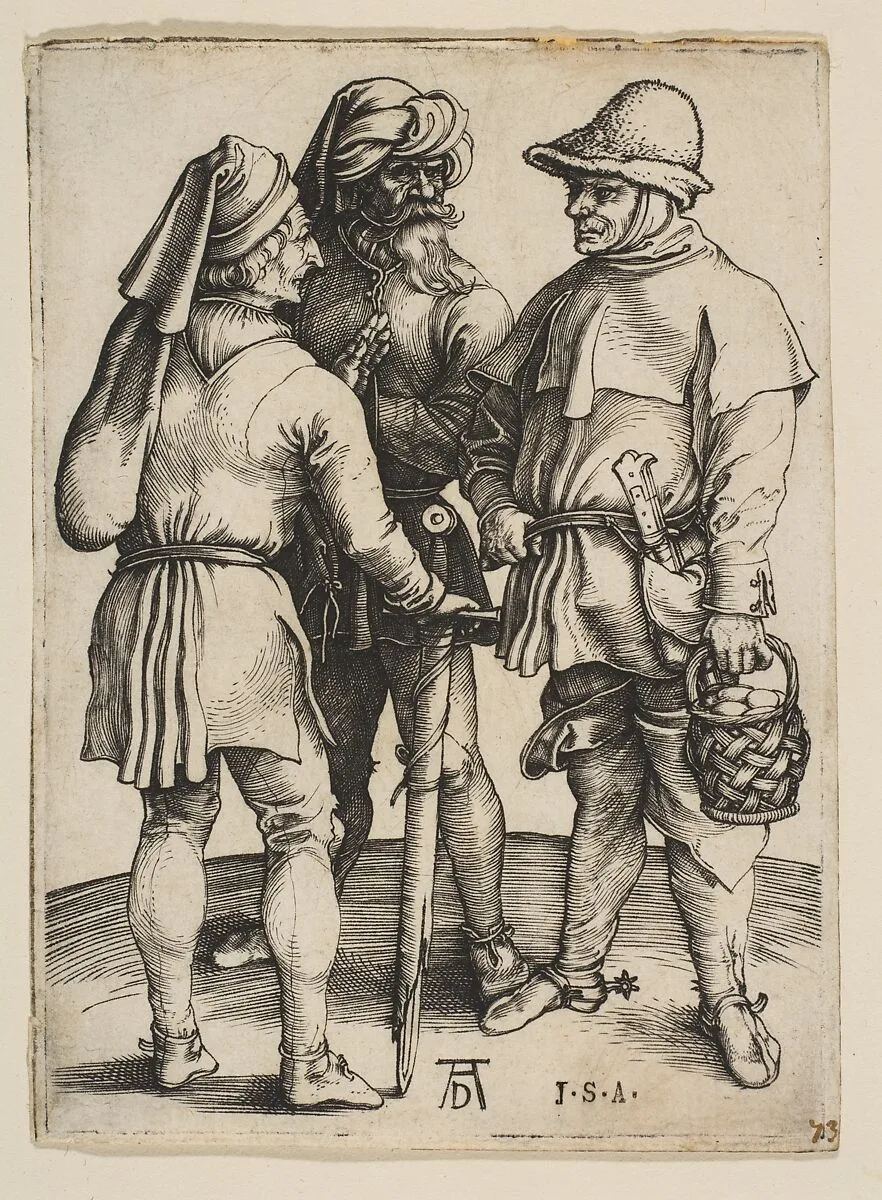 Enlarge and examine the picture
The Metropolitan Museum of Art · 19.73.98 · Fletcher Fund, 1919 · Public domain · Full frame retained; WebP encoding · Source and rights ↗ · Licence terms
A printed programme: the Twelve Articles
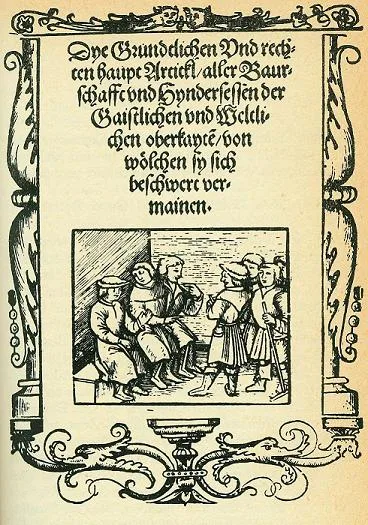
Title page of the Twelve Articles (1525), reproduced from Wikimedia Commons. This small documentary image identifies the printed programme; it is not a transcription. The exact copy, printer and shelfmark are not established by the supplied record.
Wikimedia Commons · Faithful reproduction of a public-domain two-dimensional work · Full frame and native dimensions retained; WebP encoding. Image record · Rights statement

Different answers to reform
The years 1524–1527 brought disputes that overlapped without becoming one common programme. In Zürich, disagreements about baptism and the authority to order religious change divided reformers. In Upper Swabia, communities brought religious demands together with disputes over obligations, resources and village government. Thomas Müntzer’s printed preaching and later involvement in Thuringia followed another course. Geography matters: a document produced in one setting cannot simply speak for people elsewhere. So does the kind of evidence. A village petition states demands; a confession sets boundaries for a congregation; a sermon urges an audience to act. None is a census of everyone described as a radical. Reading these works alongside one another makes comparison possible without assuming that similarity of biblical language meant agreement about political action. The question is not which single radical programme opposed Luther, but how competing reform projects understood obedience, community and legitimate force.
The Twelve Articles: gospel and village grievances
The Twelve Articles, circulated in March 1525, connected religious reform with the material conditions of village life. They sought congregational choice of pastors and changes to the use of tithes. Their rejection of serfdom did not amount to rejecting every form of authority. Other articles addressed access to hunting, fishing and woods, labour services, rents, common land, written standards of judgment and dues following a death. Several claims included qualifications about purchases or existing rights; this was not simply a demand that every obligation disappear. The final article offered to revise demands shown to contradict Scripture. That appeal helps explain why the document belongs to religious as well as social history. Calling it a fully formed modern democratic constitution would hide its own terms of justification. Equally, the demands cannot establish how every armed band subsequently behaved. A printed programme is evidence of articulated claims, not a complete record of the war.
Müntzer, revelation and the rulers’ sword
Müntzer’s printed exposition of Daniel, associated with his sermon to princes on 13 July 1524, joined biblical interpretation to a demanding account of revelation. Its discussion did not simply dispense with Scripture: claims to revelation were to be tested through biblical argument. The political consequences were nevertheless forceful. Müntzer called upon rulers to use the sword against those he presented as godless and warned that failure to act could cost them authority. His language should be read as an attempt to direct power, not as a neutral description of opponents. The surviving printed text also cannot be assumed to reproduce every word delivered in the sermon; its editorial record leaves that relationship uncertain. Müntzer later became involved in the Thuringian rising, was defeated at Frankenhausen and was executed in May 1525. Those events do not turn his programme into a reliable summary of all peasant demands or all communities practising believers’ baptism.
Luther’s changing public intervention
Luther’s interventions must also be distinguished by date and purpose. His April 1525 Admonition to Peace blamed rulers for oppression and urged conciliation, while denying that oppression entitled peasants to punish authorities through armed revolt. Addressing both sides, he proposed negotiation and concessions rather than mutual destruction. The fierce tract Against the Robbing and Murdering Hordes followed in May. Its opening explains that Luther considered circumstances to have changed since his earlier response. It accuses rebels of breaking obligations, committing violence and misusing the gospel, then urges rulers to suppress them with lethal force. These are Luther’s accusations and prescriptions. Repeating them as an independent account of every peasant community would confuse a participant’s polemic with demonstrated conduct. The surviving Nuremberg reprint makes the pamphlet a material source as well as a statement of position: readers can examine a sixteenth-century printed witness rather than relying entirely on later retellings. The sequence prevents either pamphlet from standing for an unchanging response, while the May tract requires direct attention to Luther’s endorsement of coercion.
Swiss Brethren: baptism and a different kind of community
In September 1524, Conrad Grebel and fellow Zürich reformers wrote to Müntzer while rejecting warfare and connecting baptism with professed faith and changed life. Whether the letter reached him is unknown; correspondence seeking agreement is not proof of a shared programme. The Schleitheim Articles of 1527 describe another community’s commitments. Baptism followed repentance and belief; discipline and communion defined congregational membership; pastors served the gathered church. The articles distinguished the church’s ban from the magistrate’s punishments and rejected Christian sword-bearing and oath-taking. Their separation from surrounding religious life also carried exclusionary judgments. Rejection of Christian sword-bearing therefore should not be translated automatically into modern pluralism. Schleitheim provides evidence for those who confessed these articles, not a statement accepted by every person later called Anabaptist. Its approach to force was markedly different from Müntzer’s appeal to the rulers’ sword.
Council authority, coercion and persecution
Zürich’s history places these theological differences within institutions able to prohibit, imprison and punish. The Zentralbibliothek’s account of its collections dates the first adult baptisms to 21 January 1525 and describes council prohibitions and subsequent repression. Felix Manz was drowned in 1527; imprisonment, confiscation and expulsion also shaped the regional history. This is a modern institutional account grounded in surviving holdings, not a newly transcribed eyewitness statement. It demonstrates why persecution cannot be assigned exclusively to Catholic authorities: a city undergoing Protestant reform could also suppress religious dissent. Yet the evidence should not be stretched into a uniform story about every territory or every dissenting group. Comparing the council’s measures with petitions, sermons and confessions reveals several competing ways to define a Christian community. Their disagreement concerned who could authorize religious change and what should happen to those who refused the authorized settlement.
Later Protestant histories and the memory of rebellion
J. H. Merle d’Aubigné, J. A. Wylie and Ellen G. White offered later Protestant interpretations of this crisis. D’Aubigné’s nineteenth-century narrative distinguishes the gospel from political ferment while discussing oppression and princely cruelty. Wylie likewise acknowledges peasant burdens but presents the Reformation as a remedy wrongly blamed for revolt. White’s Great Controversy places Müntzer and rebellion within a theological warning about fanaticism threatening reform. These perspectives are part of the history of remembering the Reformation, not additional eyewitness reports from 1525. They are also connected: Wylie cites D’Aubigné, and White explicitly draws on his narrative in the passages discussed here. Their agreement cannot be counted as three independent confirmations of the same incident. Reading their interpretations beside the original documents tests broad labels against distinct arguments. In particular, a characterization of Müntzer should not be transferred wholesale to Grebel, the Swiss Brethren or everyone named in the wider history of Anabaptism.