1562–1598 CE · Europe · Faith
France: conscience, worship and a conditional peace
Royal settlements distinguished private conscience, public worship and civil participation. Reading their provisions beside later Protestant histories reveals both the possibilities and the limits of a negotiated religious peace.
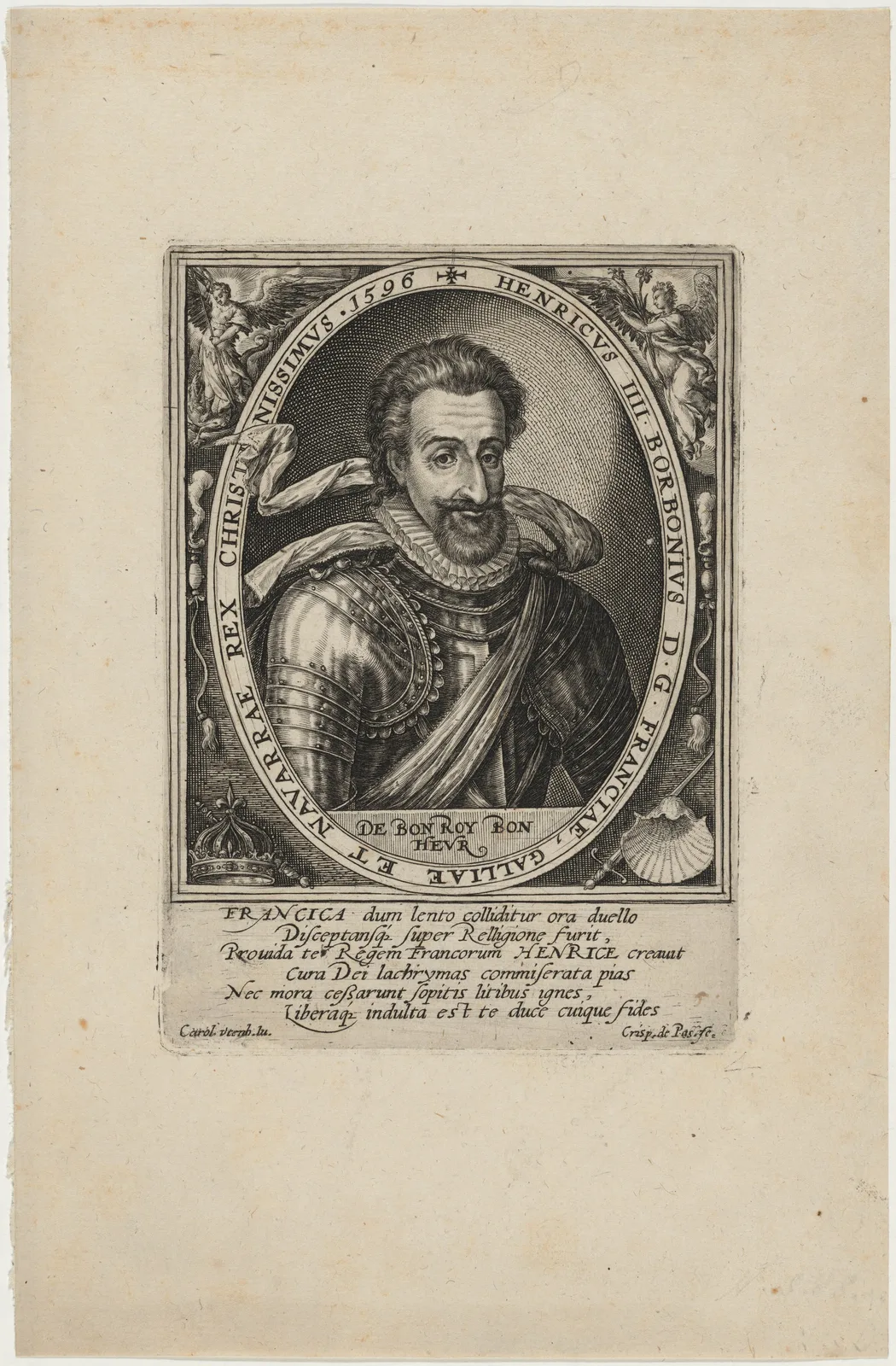 Enlarge and examine the picture
Courtesy National Gallery of Art, Washington · Rosenwald Collection · 1950.14.623 · Public domain / CC0 · Full sheet retained; proportionally reduced and encoded as WebP · Source and rights ↗ · Licence terms
Royal authority and religious difference
The January 1562 settlement offered a provisional royal arrangement for religious division. Bengt Büttner’s scholarly introduction to the later Edict of Amboise describes its conditions and the opposition surrounding registration in Paris. Religious practice was therefore also a question of political authority: who could authorize it, and on what terms? This account draws on modern scholarship, rather than an independently examined transcription of the January act.
The limits of the January settlement
As Büttner explains, the arrangement permitted daytime Protestant worship outside towns under royal supervision. These qualifications matter as much as the permission itself. It was not a grant of unrestricted worship in every location. Time, place and oversight defined the public exercise that the settlement allowed.
War and contested authority
Wassy on 1 March 1562 precipitated the first war. The Musée protestant’s modern institutional synthesis traces recurring civil conflict interrupted by fragile peace agreements. In August 1572, killings of Protestant leaders and others in Paris spread into provincial massacres. Fighting resumed, and subsequent settlements again distinguished conscience from limited public worship. Political succession added another struggle. Following Henry III’s assassination in 1589, Henry of Navarre became Henry IV but faced opposition to his rule. Paris admitted him in 1594; the April 1598 settlement at Nantes followed within this contested history. These dates provide a framework, not a complete account of the wars or contemporary eyewitness testimony. Büttner retains uncertainty about the location and circumstances of the Wassy violence. Wylie’s later Protestant narrative instead foregrounds its place in an explanation of armed resistance. His account helps explain how later readers understood that transition; it does not resolve every uncertainty or establish private intentions. The conflict involved opposing camps, and its violence should not be assigned collectively to every member of either confession.
What Nantes tried to settle
The Edict of Nantes dates to April 1598. The checked digital text follows a Paris printing of 1599, whose title records publication in Parlement on 25 February 1599. Its preamble presents the monarchy’s own explanation of pacification. Articles II–III restrain renewed accusations and restore Catholic practice. The settlement’s self-description is not independent proof that reconciliation followed everywhere.
Conscience and bounded worship
Article VI protects residence and conscience within the settlement. That protection differs from a general right to public worship. Article VII regulates certain seigneurial household observances; XIII confines religious exercise to authorized places. XIV excludes the court, Paris and the surrounding five leagues while preserving specified household protection. These provisions distribute permissions unevenly across settings. Describing them as modern religious equality would obscure the very distinctions through which the edict organized coexistence.
Civil participation
Article XXVII admits Reformed subjects to public offices. Read beside the worship restrictions, it demonstrates that civil eligibility and religious exercise were separate questions. A legal provision records an authorized rule, not every subsequent appointment or local response. The text alone cannot establish consistently successful enforcement or an enduring settlement.
Later Protestant memory and the historian’s frame
Wylie welcomes Nantes as a belated settlement while recognizing its limitations. His narrative invokes Félice: it is a later Protestant interpretation, not another eyewitness account. Ellen G. White’s Great Controversy interprets the wider French Reformation through a providential frame, connecting persecution, migration and Geneva’s contribution. Her chapter cites D’Aubigné, so agreement between these writers is not automatically independent corroboration. Neither White’s theological reading nor Wylie’s retrospective judgment establishes the edict’s legal provisions. D’Aubigné’s own preface clarifies a further difference of scope. He describes archival research into the earlier French Reformation treated in Book XII, distinguishing it from histories of later political conflict. That choice helps explain why a narrative of reform’s beginnings cannot simply stand in for the history of the wars and settlement. Reading these authors alongside the edict preserves both the historical significance of Protestant memory and the different questions answered by a legal document.