1534–1563 CE · Europe · Faith
Catholic renewal: Trent, mission and formation
A new religious society and an interrupted council pursued preaching, instruction, doctrinal definition and clerical reform. Their programmes shaped Catholic renewal, while their implementation varied across places and institutions.
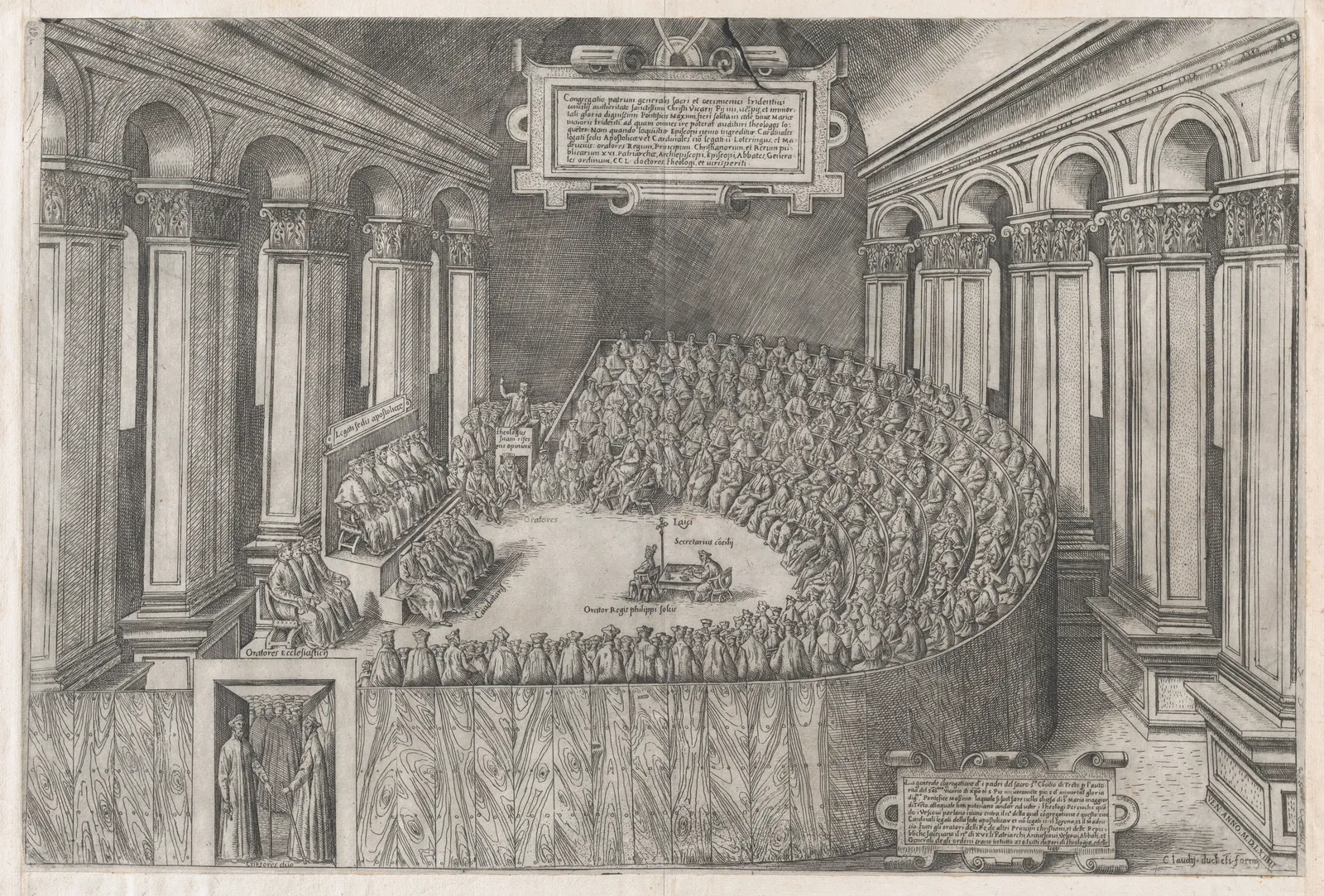 Enlarge and examine the picture
The Metropolitan Museum of Art · Harris Brisbane Dick Fund,1941 ·41.72(3.70) · Public domain · Full supplied sheet retained; proportionally reduced and encoded as WebP · Source and rights ↗ · Licence terms
Calls for reform and an interrupted council
Calls for Catholic reform came from humanists and clergy as well as from conflicts with Protestant movements. They concerned religious life and the conduct of church institutions. Under Paul III, a council opened at Trent in 1545. Its twenty-five sessions extended across eighteen years, with interruptions, rather than forming one continuous meeting. That chronology matters: decisions issued in 1546, 1547 and 1563 belonged to different stages of a prolonged undertaking. Catholic renewal included institutional initiatives alongside the council’s work.
Companions, papal approval and a mission
Ignatius and his companions took vows in Paris in 1534; Paul III approved the Society of Jesus in 1540. Those were distinct stages, not interchangeable founding dates. The 1540 Formula of the Institute described a society devoted to ministry of the word, spiritual exercises, charitable activity and Christian instruction of children and people without formal learning. Its members were to be available for missions assigned by the pope, under their superior’s direction. Kindness and charity formed part of the stated norm. These provisions joined a mobile mission to an organized religious community. They describe what the approved institute proposed to do, rather than providing a record of every subsequent member’s conduct.
Instruction, schools and different kinds of formation
Ignatius became the Society’s superior in 1541. A school at Messina in 1548 provides a concrete example of its educational activity. The charter’s concern for Christian instruction connected teaching with religious mission, but a school and a seminary were not identical institutions. The later Tridentine seminary programme addressed preparation for clerical service within dioceses. Keeping these settings distinct prevents a single story of education from concealing differences of audience and purpose. Teaching could serve a religious society’s work among learners, while clerical formation answered responsibilities assigned to church authorities.
Scripture, tradition and the doctrine of justification
On 8 April 1546, Trent’s fourth session received the biblical books and transmitted unwritten traditions with equal reverence, specified a scriptural canon and condemned deliberate rejection. The decree established doctrinal boundaries. Its language of anathema does not itself document a particular civil penalty or prove that all Catholic Bible reading was prohibited. The decree on justification, issued on 13 January 1547, likewise requires attention to its actual distinctions. It described faith as the beginning of salvation and the foundation and root of justification and denied that anything preceding justification, whether faith or works, merited its grace. The text linked faith with hope and charity and warned against resting forgiveness on confidence in one’s own remission alone. This conciliar teaching cannot accurately be reduced to earning salvation independently of grace. Nor does presenting its terms settle the contemporary disagreements that made doctrinal definition consequential.
Seminaries and the preparation of clergy
On 15 July 1563, the twenty-third session prescribed seminaries according to diocesan means. Its reform decree set a minimum age of twelve, required literacy and considered candidates’ disposition toward ecclesiastical service. Poorer candidates received preference, while wealthier pupils could be admitted at their own expense. These provisions connected religious formation to recruitment and material support. They also show that the programme was directed toward a particular clerical purpose, rather than universal schooling for all children. Diocesan resources formed part of the mandate itself. The decree therefore established an obligation and a framework for training; its promulgation did not demonstrate that every diocese immediately possessed a functioning institution.
Decisions, reception and later Roman interpretation
The council’s decrees and the history of their implementation must be distinguished. Episcopal reforms took effect unevenly across regions, while reform of the Roman curia and the work of new religious orders received limited attention within the council itself. Papal confirmation in 1564 and subsequent centralized interpretation were further stages, after the council had closed. Catholic renewal consequently involved more than the publication of a set of decrees. Regional institutions and later decisions shaped their reception. The distinction preserves both the importance of Trent’s programme and the limits of treating its prescriptions as a description of religious life everywhere.
Later Protestant readings of Catholic renewal
J. A. Wylie’s later Protestant history acknowledged Jesuit colleges’ teaching of Latin and science and described Protestant parents sending children to them. Yet he framed Catholic revival as a threat to Protestant liberty. His schools discussion cited Ranke, whose work is not an additional independently examined witness here. Ellen G. White’s Great Controversy presented the Jesuits through a strongly adversarial theological interpretation, treating education and charity within a narrative of concealed power. That is her polemical frame, not a verified description of the charter or every Jesuit. These later interpretations show how Catholic renewal entered Protestant historical memory; neither is contemporary corroboration of the events described.