1519–1531 CE · Europe · Faith
Zwingli, Zurich and Marburg: Scripture, reform and disagreement
A surviving manuscript brings us close to a divided Reformation. Explore Zurich’s civic reforms, the Marburg dispute and the ways later Protestant historians understood their spiritual meaning.
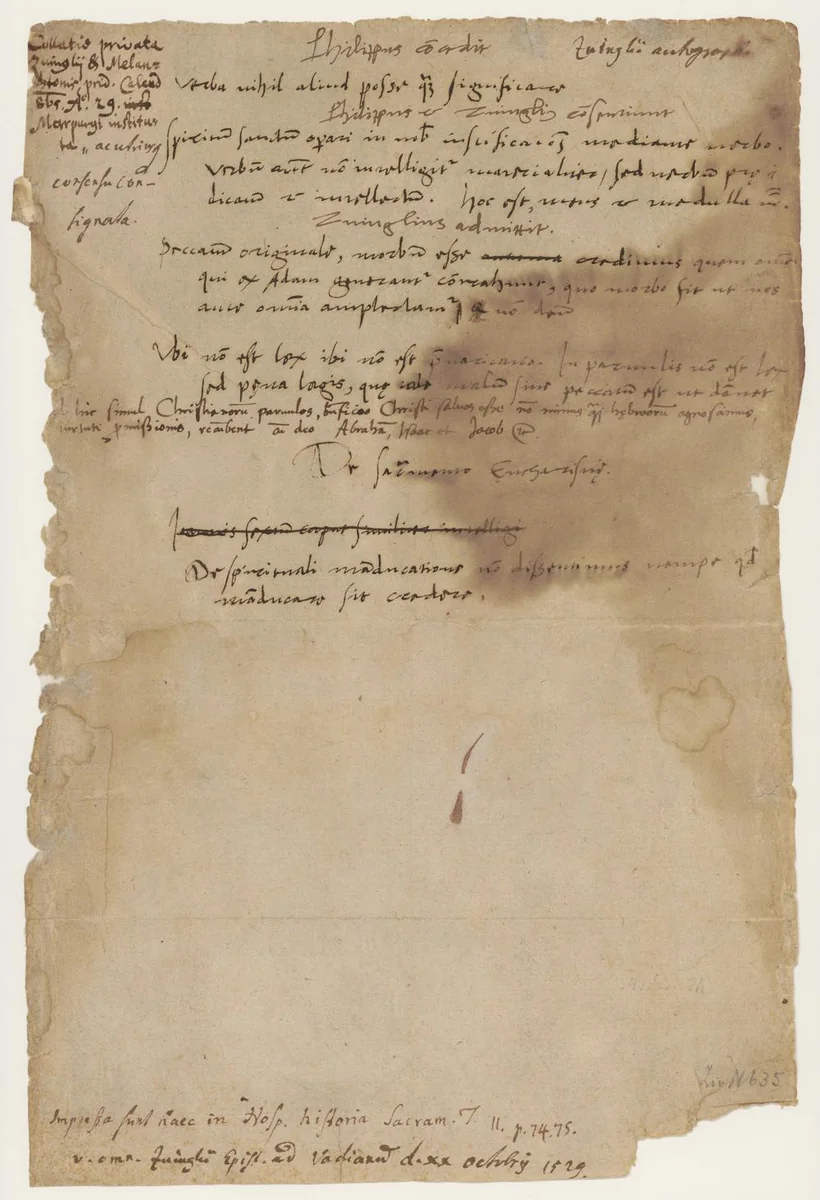 Enlarge and examine the picture
Huldrych Zwingli / Zentralbibliothek Zürich · Ms Z XI 313.1 · e-manuscripta.ch · Public Domain Mark · Resized without cropping and converted to WebP · Source and rights ↗ · Licence terms
Scripture in a city of reform
Huldrych Zwingli began his ministry at Zurich’s Grossmünster on 1 January 1519. On 29 January 1523, the city council approved reform after a public disputation. Municipal government, rather than a single protecting prince, gave the movement institutional force. Zwingli studied the Greek New Testament published by Erasmus and copied Paul’s letters. Although he maintained that his convictions developed independently of Luther, he also encouraged the circulation of Luther’s writings. Reform grew through reading, preaching and exchange, not complete intellectual isolation.
Worship, wealth and civic authority
Zurich’s reforms changed worship and removed religious images from churches. Monastic property passed into new arrangements for education and poor relief, but the city archive warns against an exclusively charitable picture: revenues also served public debt and territorial interests. The marriage court established in 1525 extended civic and clerical supervision into domestic life. Bible-centred reform therefore altered both religious teaching and the institutions governing residents. Its effects cannot be measured by doctrinal statements alone.
Examine a manuscript, not an imagined meeting
The pictured page belongs to Zwingli’s Latin record of a conversation with Philipp Melanchthon at Marburg, dated 30 September 1529. Zentralbibliothek Zürich preserves the four-page manuscript as Ms Z XI 313.1. This is a photograph of the historical document, not a reconstruction of the participants around a table. Its handwriting is not silently translated here. It must also be distinguished from Zwingli’s later letter to Vadian, dated 20 October, which describes the gathering from his own position.
Marburg and the limits of agreement
Philip of Hesse sought agreement between reformers at Marburg in 1529. The Lord’s Supper remained a decisive division: Luther insisted on Christ’s bodily presence, while Zwingli rejected that understanding and emphasized a symbolic and spiritual reading. The surviving accounts are partisan. Zwingli’s letter presents his arguments confidently; Andreas Osiander’s report favours the Lutheran side. Reading them together reveals disagreement rather than a neutral transcript or a single, uniform Protestant position.
Reading D’Aubigné and Wylie critically
D’Aubigné’s nineteenth-century history places Swiss reform within a providential recovery of Christianity and contrasts its civic setting with princely Germany. His language of democracy should not be confused with modern universal political participation. Wylie likewise interprets the Swiss movement as divinely grounded. In Book XI he defends protective political alliances but criticizes the food blockade during the crisis preceding Kappel. These are substantial Protestant interpretations, worth reading in their own terms, not eyewitness accounts or substitutes for institutional records.
The Great Controversy and a shared source tradition
In chapter 9 of The Great Controversy, Ellen G. White presents Zwingli’s ministry as a Bible-centred witness to salvation through Christ, with faith bearing fruit in conduct. She explicitly draws on Wylie and D’Aubigné. Their agreement therefore cannot be counted as three independent eyewitness confirmations. This study includes that confessional reading openly, while keeping the manuscript, chronology and civic consequences distinguishable from the later theological meaning assigned to them.
Coercion, conflict and an unfinished settlement
Not everyone who sought reform accepted the council’s settlement. Conrad Grebel, Felix Manz and other Anabaptists challenged religious and social arrangements; authorities imprisoned leaders and executed several dissenters. Zurich’s reformation was not universal freedom of conscience. Conflict between Swiss cantons also involved mercenary service and political power. Zwingli died in the second war of Kappel on 11 October 1531. His death did not end Swiss reform, nor did reform erase confessional division. This chapter is a focused introduction, not a complete history of the Swiss churches.