1524–1536 CE · Europe · Faith
Tyndale and Coverdale: the English Bible, exile and reform
An English Bible was more than a new printed book: it raised questions about who could interpret Scripture. Tyndale’s translations, Coverdale’s complete Bible and later Protestant histories reveal both the struggle and its remembered meaning.
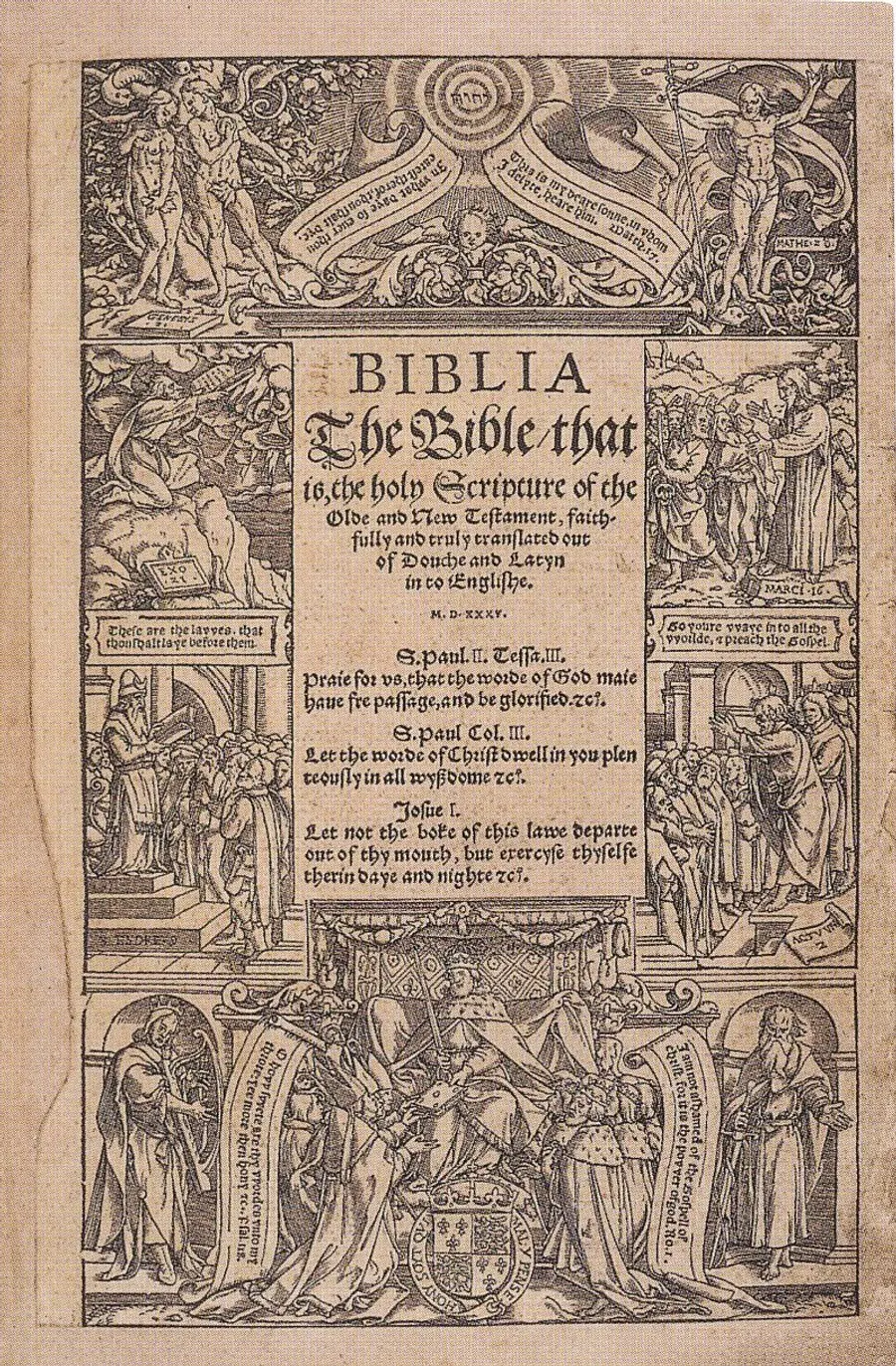 Enlarge and examine the picture
Hans Holbein the Younger / British Library, via Wikimedia Commons · Public domain · Resized and converted to WebP · Source and rights ↗ · Licence terms
Translation across borders
After failing to obtain episcopal support, William Tyndale left England in 1524. His English New Testament was completed at Worms in 1526 and smuggled into England, where authorities suppressed and burned copies. His translation of the Pentateuch from Hebrew followed in 1530. A revised New Testament appeared in 1534. Exile, language study, printers and readers all belonged to this religious undertaking; it was not simply an English royal initiative.
A translator addresses his readers
Tyndale’s 1526 preface asks readers to distinguish the demands of law from the promises of the gospel. It also acknowledges an unfinished translation: he proposes correcting omissions, improving English expressions and explaining unfamiliar words. This primary text joins evangelical conviction to practical revision. The linked digital transcription modernizes spelling and includes editorial material; it is not a photograph of the original printing.
D’Aubigné’s spiritual account
In Book XVIII, chapter IV, D’Aubigné presents vernacular Scripture as the spiritual foundation of English reform, contrasting Tyndale’s purpose with Wolsey’s ambition. Importantly, he explains that his vivid Sodbury table conversation was drawn from Tyndale’s writings. Readers should therefore treat it as a nineteenth-century historical reconstruction of convictions, not a stenographic record. His Protestant interpretation is part of this chapter’s evidence, openly identified rather than silently adopted.
Coverdale’s complete Bible
Miles Coverdale’s 1535 publication was the first printed whole Bible in English. He revised Tyndale’s New Testament and collated Old Testament translations by Tyndale and others. The pictured title page is an actual historical document, with biblical scenes framing its English title. It should not be mistaken for Tyndale’s 1526 edition, or proof that Coverdale independently translated every book from its original language.
Persecution and Protestant memory
Tyndale was arrested in 1535 and executed for heresy in 1536. In The Great Controversy, chapter 14, Ellen G. White interprets his work and martyrdom within a providential struggle over access to Scripture. She explicitly cites D’Aubigné, showing how earlier Protestant history shaped later religious memory. That interpretation deserves to be read in its own voice, while dates and publication history are checked independently. No purported last words are presented here as eyewitness fact.