1517–1522 CE · Europe · Faith
Luther: indulgences, conscience and the German New Testament
A dispute about indulgences became a confrontation over salvation and authority. Letters, printed portraits and surviving books help distinguish Luther’s actions from later Protestant accounts of their meaning.
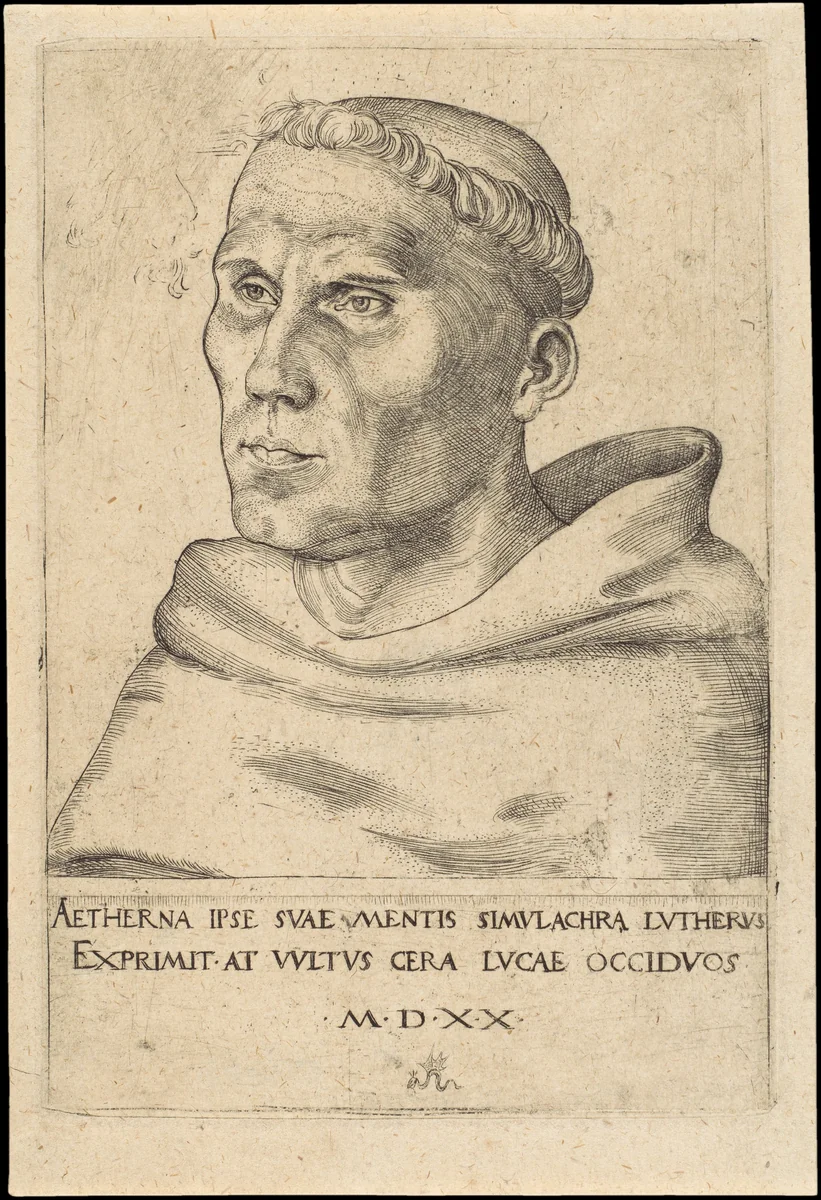 Enlarge and examine the picture
The Metropolitan Museum of Art, 20.64.21 · Gift of Felix M. Warburg, 1920 · Public domain / Open Access · Resized and converted to WebP, uncropped · Source and rights ↗ · Licence terms
1517: a pastoral dispute becomes public
On 31 October 1517, Luther wrote to Archbishop Albrecht of Mainz about indulgences. His letter reported people treating purchased letters as assurances of salvation; he acknowledged that he had not personally heard the preachers. The Ninety-Five Theses challenged this confidence. Indulgences concerned penalties for sin, not a straightforward licence to sin. Wylie’s later narrative interprets this controversy as the opening of a providential liberation.
Justification: faith and the place of works
Luther argued that acceptance by God depended on grace through Christ, received in faith, rather than accumulated merit. This did not mean that conduct was irrelevant: his treatment of good works made them follow faith rather than purchase salvation. D’Aubigné presents this teaching as a recovery of Paul’s gospel. That is a Protestant theological interpretation, not a historical demonstration that one confession possesses divine approval.
Printing a reformer’s public identity
Pamphlets carried the controversy beyond university disputation. Cranach’s 1520 engraving, shown here, presented Luther in his Augustinian habit while his writings challenged ecclesiastical authority. It is a contemporary printed portrait, not a photograph or a depiction of the 1517 protest. The surviving object reveals how a recognisable author accompanied circulating arguments; it does not establish that all readers accepted those arguments.
1521: conscience before the Diet of Worms
Excommunicated in January, Luther appeared before the imperial Diet on 17 and 18 April 1521. He refused to retract without being convinced through Scripture and argument. His appeal bound conscience to what he believed was God’s word, rather than proclaiming unrestricted personal preference. Wylie and White emphasise courageous faith; the municipal chronology also reveals imperial politics and princely protection. The familiar “Here I stand” wording is not treated here as a securely recorded quotation.
1522: translation and collaboration
Protected at the Wartburg after Worms, Luther worked on a German New Testament. D’Aubigné describes subsequent revision with Melanchthon; the September Testament appeared at Wittenberg in 1522. Its survival provides material evidence alongside the narrative. White interprets vernacular Scripture as an instrument of religious renewal. Translation, revision, printing and distribution were connected activities, not simply a solitary moment of inspiration.
Reading Protestant histories critically
Wylie and D’Aubigné wrote centuries after these events; White’s 1911 account explicitly quotes D’Aubigné. Their accounts are valuable witnesses to Protestant remembrance, but repetition does not make them independent eyewitnesses. Their claims about providence are identified as beliefs. Contemporary correspondence, portraits and surviving editions anchor this study’s chronology without requiring readers to adopt those later authors’ judgments of rival Christians.