650–1300 CE · Asia · Trade
Srivijaya: rivers, seaways and Buddhist learning in early Indonesia
Early Indonesian history was shaped by river communities, ports and religious journeys. Srivijaya connected southern Sumatra to wider Asian exchange without resembling a modern nation with fixed borders.
 Enlarge and examine the picture
Gunawan Kartapranata / Wikimedia Commons · CC BY-SA 4.0 · Resized and converted to WebP; derivative under the same licence · Source and rights ↗ · Licence terms
A maritime power with a Sumatran heartland
Srivijaya flourished from roughly the seventh to thirteenth centuries, with a principal centre in southern Sumatra. Maritime influence reached beyond one island. John Guy describes a loosely connected political and commercial network around the Straits, probably centred on Palembang. A modern map of Indonesia should not be projected backward as its exact territory.
From river producers to overseas ports
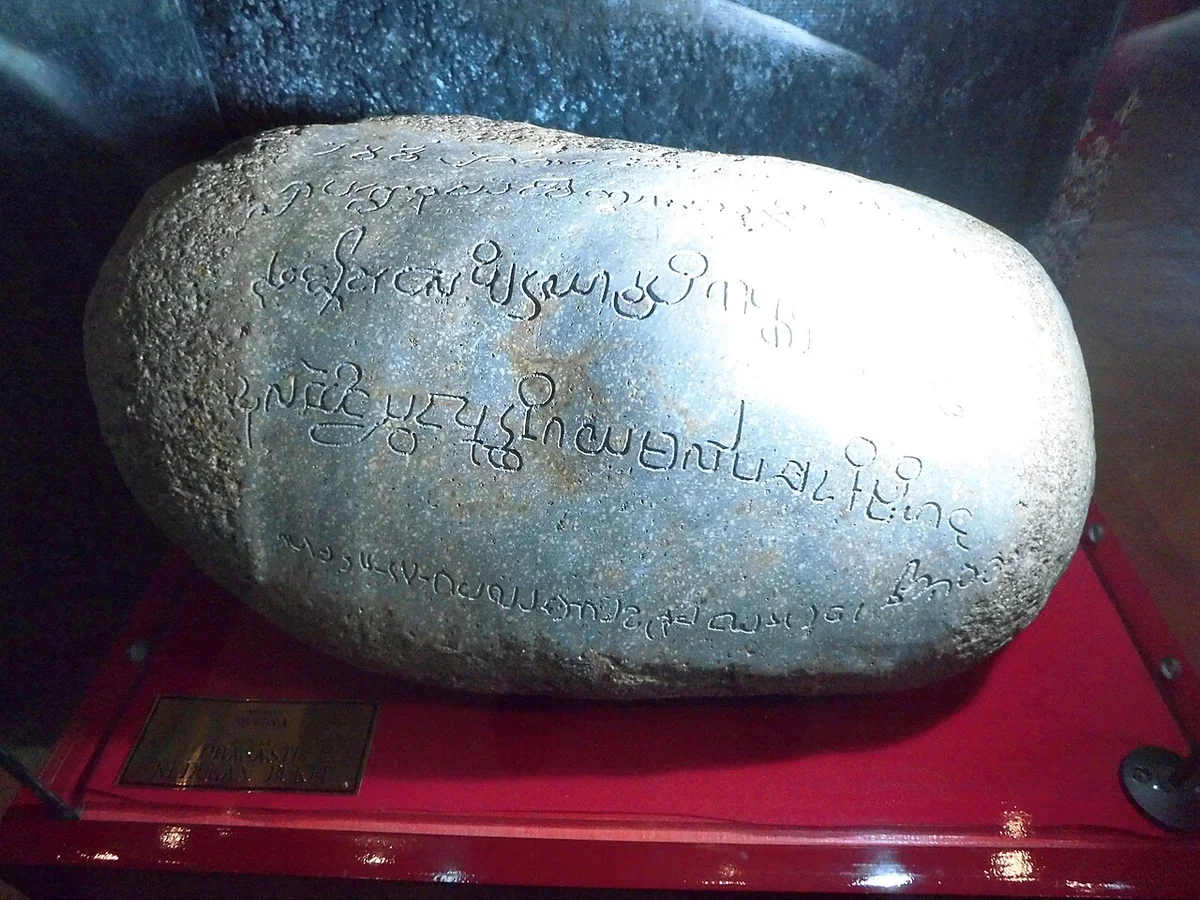
The Kedukan Bukit inscription is dated to 682. Archaeological study of boats and the Musi and Batanghari watersheds connects inland production with coastal commerce. Forest products, resins and gold moved through collecting points and river routes. Boats, local labour and relationships with upstream communities were as important to maritime power as ocean-going ships.
Learning travelled with commerce
In 671 the Buddhist monk Yijing sailed from Guangzhou aboard a Persian merchant ship and reached Srivijaya on his way to India. Scholarship and pilgrimage used the same maritime connections as goods. Srivijaya became a centre for Buddhist and Sanskrit learning; this history joins religious institutions to the movement of people, languages and material objects.
Evidence, not a single origin story
The photograph records the Kedukan Bukit stone in a museum display. Its inscription supplies a dated record, not a complete account of every community under Srivijayan influence. The later Belitung wreck provides a different kind of evidence for ninth-century Asian trade. Srivijaya, Java’s Buddhist monuments and later Majapahit should not be collapsed into one timeless Indonesian empire.