1875–1970 CE · Oceania · Rights
Tonga: constitution, land and the boundaries of sovereignty
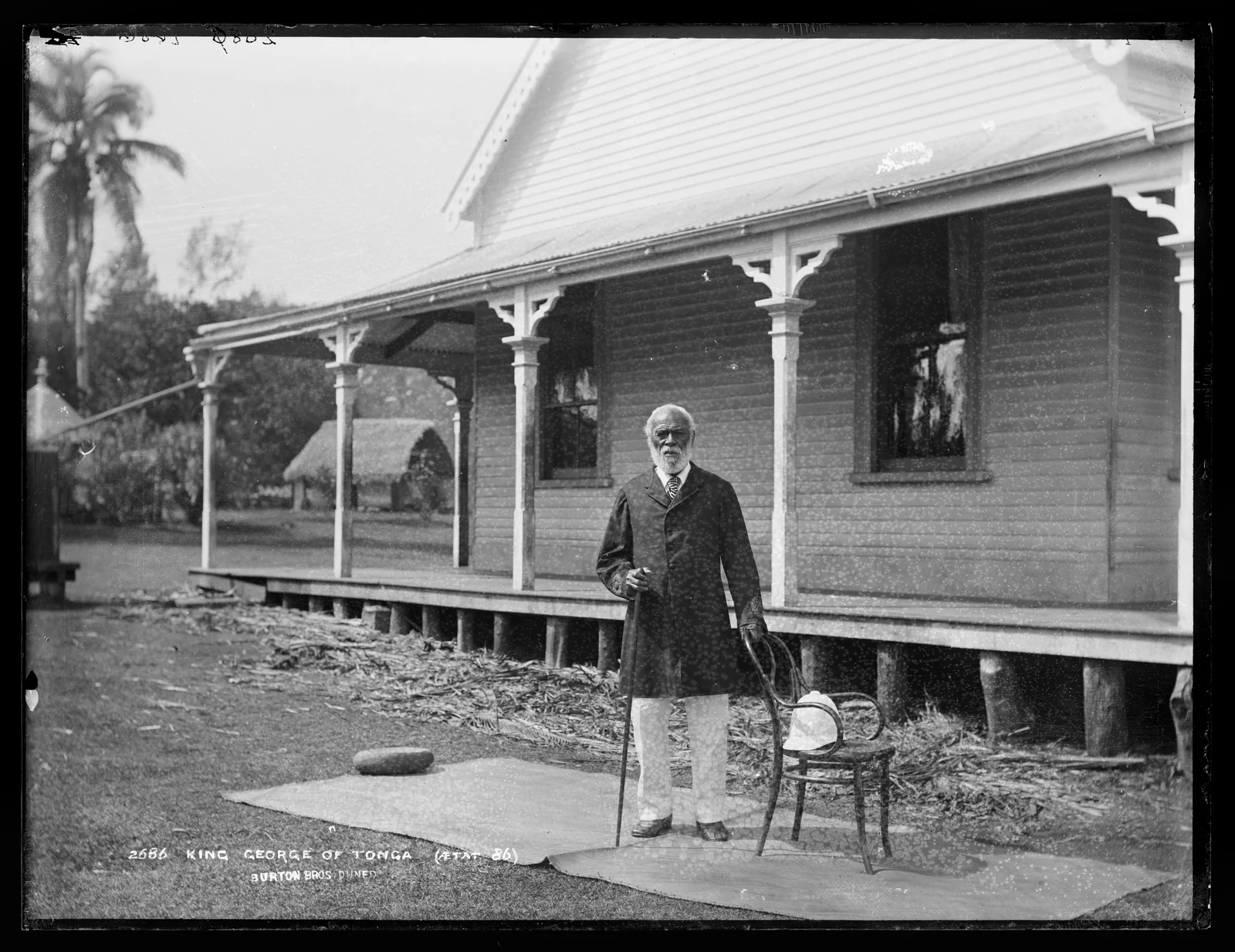
A portrait of George Tupou I introduces a kingdom that combined constitutional rights, inherited rank and regulated landholding. Historical legal editions and parliamentary records distinguish the 1875 settlement, British protection, women’s franchise and the recovery of responsibility for external affairs in 1970.
 Enlarge and examine the picture
Alfred Burton / Burton Brothers studio / Museum of New Zealand Te Papa Tongarewa · C.017629 · No Known Copyright Restrictions (New Zealand law) · Whole-frame reduced WebP derivative · Source and rights ↗ · Licence terms
An identified king, photographed after the constitution
Te Papa identifies George Tupou I in Alfred Burton’s photograph of 26 July 1884. The king stands with a walking stick beside a chair outside a wooden building. The surviving border and lower inscription locate this particular photographic record. Its formal pose offers evidence of royal presentation, rather than a view of constitutional debate or the experiences of ordinary landholders. The photograph was made after the 1875 constitution. It cannot establish how people understood that settlement, and its inscribed age is not treated here as an independently verified birth date.
Building a constitutional kingdom in a connected Pacific
Tonga’s Parliament places the opening of the assembly to discuss the new constitution on 16 September 1875. Its history connects this institution with the earlier chiefly council, the Fakataha, and with efforts to safeguard sovereignty. Charles St Julian supplied George Tupou I with the Hawaiian Constitution of 1852, one influence on the new framework. The original assembly combined government officials, twenty nobles appointed for life and twenty elected representatives of the people. These connections show both local political purposes and exchanges across the Pacific. Elected representatives formed part of a monarchy with privileged chiefly institutions; their presence alone does not establish equal participation by the entire population.
Rights in a historical legal edition
The government’s 1907 law compilation includes a constitution recording amendments through December 1888. This amended text supplies the clauses discussed here. Clauses 1 and 2 declare personal freedom and oppose compulsory service, with stated legal exceptions. Clause 4 promises a common law for chiefs and commoners, Europeans and Tongans. Clauses 5–9 provide worship, speech, petition and habeas corpus protections alongside religious observance and specified restrictions. Such provisions must be read with the same edition’s hereditary offices and royal legislative sanction. Constitutional rights and unequal political rank operated within one legal order.
Land security had different terms for different holders
In that 1907 appendix, clause 109 vests land in the king, permits hereditary estates and prohibits land sales while allowing regulated leases. Clause 115 requires registration of leases and transfers. Clause 119 makes tax lands descend through the male line, while permitting a widow’s continued holding subject to conditions. These distinctions separate Crown title, chiefly estates, household use and leasehold interests. They also show why a general statement that women possessed no land rights is too broad. This is a reading of an early twentieth-century printed legal record. It neither backdates every provision to 1875 nor describes present-day law.
Protection changed external power without ending the kingdom
The Tongan government’s treaty register dates the Treaty of Amity with Britain at Nukuʻalofa to 18 May 1900. Explaining the relationship in 1970, British minister Evan Luard described protection under the 1900 treaty and subsequent amendments and replacement treaties. Britain had responsibility for foreign affairs and defence, while Tonga retained its kingdom and governing institutions. The arrangement changed over time: Luard identified the 1968 settlement as giving Tonga complete responsibility for internal affairs, with a defence-legislation exception, and greater external responsibility. His statement is a British governmental explanation, not a substitute for every Tongan participant’s assessment of the relationship.
Women’s franchise: a legal change and an implementation problem
Clause 64 of the official 1988 revised constitution annotates its male-and-female elector provision to Act 15 of 1951. It retains age, literacy and other qualifications, including a tax condition for male non-nobles. Parliament’s later institutional account also dates women’s voting rights to 1951. Practice requires separate evidence: a June 1954 correspondent’s report, published in Pacific Islands Monthly that July, said a technical legislative error had prevented women voting in the election of 28 May. Its expectation that the next election would remedy the problem is a forecast, not proof of a first ballot. This chapter therefore distinguishes statutory enfranchisement from demonstrated participation without assigning an unsupported first-voting date.
1970 restored external responsibility; other histories continue
The Tonga Act 1970 specified 4 June as the appointed day when Tonga would cease to be a protected state for British legal purposes. Luard explained the planned return of foreign-affairs and defence responsibility through an exchange of letters. This was a change in the external position of an existing kingdom, with constitutional institutions and legal inequalities that had their own histories. The end of protection and the earlier expansion of voting rights were distinct developments. This focused chapter follows a particular constitutional and landholding order; Tonga’s earlier societies, other islands and communities, later political reforms and the wider Pacific remain subjects for further study.