1899–1962 CE · Oceania · Rights
Samoa: colonial rule, the Mau and independence
A colonial photograph, Samoan testimony and constitutional records connect partition, resistance and the independence of Western Samoa. This focused chapter distinguishes changing administrations, women’s organizing and the limits of political inclusion.
 Enlarge and examine the picture
Thomas Andrew / Museum of New Zealand Te Papa Tongarewa · C.001438 · No Known Copyright Restrictions (New Zealand law) · Unchanged JPEG · Source and rights ↗ · Licence terms
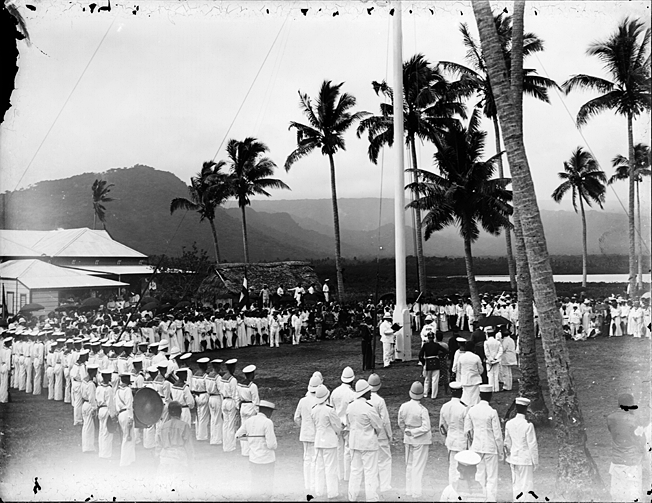
A flag ceremony and an imperial partition
Thomas Andrew photographed the raising of Germany’s flag at Mulinuʻu, Apia, on 1 March 1900. The museum identifies sailors and policemen around the flagpole. This is a picture of an imperial ceremony, not a photograph of the later Mau movement or proof of Samoan consent. The preceding convention, signed by representatives of Germany, Britain and the United States on 2 December 1899, rearranged those powers’ claims. Article II distinguished Tutuila and the islands east of 171° west from Upolu, Savaiʻi and the western islands. No Samoan representative appears among its signatories. The document records an agreement between imperial governments; it should not be mistaken for a compact expressing all island communities’ wishes.
German rule and the Mau a Pule
Archives New Zealand identifies the orator and chief Lauaki Namulauʻulu Mamoe with the Mau a Pule, an earlier resistance movement on Savaiʻi. Governor Wilhelm Solf deported him and other supporters to Saipan in 1909. The archive presents a colonial compilation describing opposition to German rule. That administrative framing needs scrutiny: the earlier movement should not make every later Mau campaign an unchanged organization, or every Samoan a supporter.
Occupation, epidemic and a League mandate
New Zealand occupied German Samoa in 1914, during the First World War. The later League of Nations mandate, allocated in 1920, was a different legal arrangement from military occupation. Between those changes came the influenza disaster of 1918. NZHistory estimates that more than one-fifth of the local population died and connects the administration’s handling of the epidemic with grievances against colonial government. That estimate concerns the western territory discussed by the source, not an undifferentiated count for the entire archipelago. International supervision did not itself give Samoans control of the administration. The subsequent United Nations trusteeship also needs its own date rather than being projected back into 1918.
Samoan claims in a mediated record
Tamasese’s further examination on 30 September 1927 brings Samoan political argument into the record. He criticized the removal of chiefly titles, restrictions on fine-mat ceremonies, medical taxation and the nomination of representatives without the district’s choice. Questioned about the Mau’s purposes, he supported government by Samoans, with British protection against attack by other countries. The exchange therefore expresses a particular proposal for authority and external protection, rather than a simple demand that every foreign connection disappear. It survives in an English-language colonial commission report published in 1928. Questions, interpretation, editing and later OCR mediate the witness’s words. This is evidence of his stated position within that encounter, not an unedited Samoan-language speech or a formula that can automatically be assigned to every Mau participant.
Black Saturday and a disagreement about numbers
On 28 December 1929, an attempted arrest during a Mau parade in Apia led to confrontation and police gunfire. Tupua Tamasese Lealofi III was mortally wounded while trying to restrain the crowd. The institutional histories differ about fatalities: NZHistory reports eight Samoans and one New Zealand policeman dead, while Archives New Zealand reports eleven Samoans killed. This chapter attributes both counts without inventing a common total or guessing why they differ. The disagreement should remain visible rather than being silently resolved through arithmetic or an assumed reporting period.
Women sustained political action
NZHistory describes residents providing food, shelter and information to Mau supporters pursued by armed forces. It also records women rallying supporters and staging demonstrations when men faced arrest. Women appear here as organizers, not merely as relatives of male leaders. This institutional synthesis does not recover every participant’s experience or a single position shared by all women; fuller Samoan testimony and family histories remain needed.
Trusteeship, independence and restricted representation
The trusteeship agreement approved on 13 December 1946 named New Zealand as administering authority for Western Samoa. Its articles defined the western islands and called for political advancement towards self-government or independence, with attention to the people’s expressed wishes. Samoa’s parliamentary history records a 1946 independence petition and constitutional conventions in 1954 and 1960. Independence and the first Parliament followed on 1 January 1962. This was the western state, not independence for American Samoa or the whole archipelago. Sovereignty also did not immediately mean an equal vote for every adult: the parliamentary history describes Indigenous electoral participation restricted to matai, alongside a separate individual electorate for European and other non-Indigenous voters. It dates the extension of adult voting rights to 1990. These distinctions make this a focused account of colonial rule and political change, not a complete history of Samoa.