1874–1970 CE · Oceania · Rights
Fiji: cession, labour and the terms of independence
A Rewa River photograph, migration records and constitutional documents connect colonial rule with labour and political representation. This focused chapter distinguishes Indigenous Fijian workers, Indian indentured migrants and the unequal terms of inclusion before and at independence.
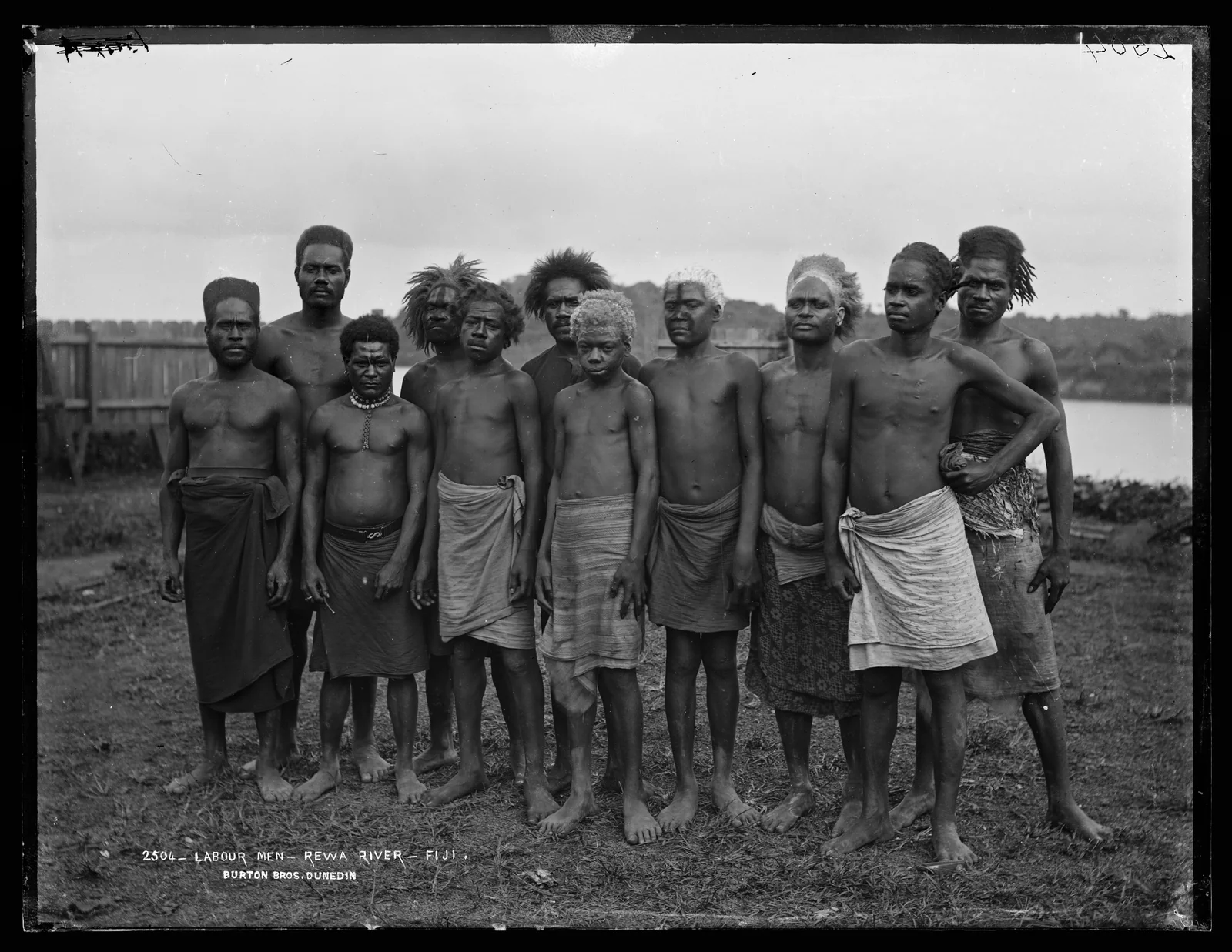 Enlarge and examine the picture
Alfred Burton / Burton Brothers studio / Museum of New Zealand Te Papa Tongarewa · C.017409 · No Known Copyright Restrictions (New Zealand law) · Whole-frame reduced WebP derivative · Source and rights ↗ · Licence terms
Read the photograph before supplying a story
Te Papa identifies this as Alfred Burton’s June 1884 photograph of labourers near the Rewa River, Viti Levu. Its catalogue describes eleven men and boys and associates the record with Fijian people. It is not identified as a portrait of Indian indentured migrants. The posed group, plate inscription and surviving border belong to this particular photographic record. Their individual names, employment terms and views about colonial rule are not supplied by the image. Those limits matter when a photograph introduces several different labour histories.
Cession transferred sovereignty, not a uniform popular voice
The Deed of Cession was signed at Levuka on 10 October 1874. Its signatories included Cakobau, Maʻafu, other high chiefs and the British representative Hercules Robinson. Clause 1 ceded sovereignty; clause 2 placed the constitution and laws under the Crown’s determination. Clause 4 dealt with land through distinctions involving prior alienation, use, occupation and anticipated chiefly or tribal needs. Clause 7 qualified recognition of chiefly rights by British sovereignty and colonial government. These provisions should not be reduced to a claim that every person consented or that every parcel of land became interchangeable Crown property. This reading uses a transcription of the English instrument, including its interpreter’s certificate, rather than a newly inspected original deed.
Girmit and the records of migration
Indian indentured migration to Fiji extended from 1879 to 1916. The National Library of Australia explains that workers were normally contracted for five years and could face criminal prosecution for leaving the estate. A free return passage was conditional, rather than automatic at the end of that first term. Its guide describes separate emigration passes for adults, children and infants, with names, relatives, places of origin and other personal details. The original documents are held by the National Archives of Fiji. Such forms can recover family connections, but official spellings and categories are not unmediated accounts of migrants’ intentions. ANU’s company archive separately connects Indian contract labour with the sugar industry and employers including CSR. The photographed Fijian group must not stand in for these migrants.
Women organized rather than merely endured
Historian Margaret Mishra traces the Indian Women’s Committee and women’s opposition to exploitation. Her account distinguishes Jaikumari Manilal’s petitions, meetings and organizing from physical confrontations in which other women participated. In 1920 the committee sought higher wages and an inquiry into rising food prices. These were political and economic claims, not simply an extension of domestic roles. Mishra also examines overseas reformers whose campaigns for health care could reproduce restrictive ideas about women’s morality. Her study mediates colonial files, newspapers and earlier scholarship; those voices should not be presented as one transparent testimony or a single position shared by every woman.
Ending indenture did not end workers’ histories
In February 1920 a British minister told Parliament that remaining indentures had been cancelled that January. The oral answer gives 1 January; the written answer gives 2 January. This chapter records the month without silently choosing between those contemporary reports. It also distinguishes cancellation from the last indentured migration voyages in 1916. ANU’s archive notes that by 1925 most of the Indian workers brought to Fiji had made homes there. Ending contracts therefore did not mean that everyone returned to India, acquired identical livelihoods or ceased to make political claims.
Expanding the vote and negotiating government
The Inter-Parliamentary Union dates women’s voting rights in Fiji to 1963, before independence. Fiji’s parliamentary history describes the 1966 election contested by the Federation and Alliance parties, followed by ministerial government in 1967 with Ratu Kamisese Mara as chief minister. It places the agreement leading to independence in the London constitutional conference of April–May 1970. These changes distinguish access to voting, executive responsibility and sovereignty; they were not one simultaneous grant of equal political power.
Independence retained classified representation
The Fiji Independence Act ended the United Kingdom government’s responsibility for Fiji on 10 October 1970. Independence retained ethnic classification in representation. Section 32 of the 1970 Constitution, read here in its 1978 printed edition, provided fifty-two House seats: twenty-two for candidates on the Fijian roll, twenty-two on the Indian roll and eight on the roll for people classified as neither. Of these, twelve, twelve and three seats respectively were elected by the corresponding communal rolls; the remaining ten, ten and five were elected by the national roll. Both the reserved candidate categories and the mixed electoral arrangements matter when assessing political inclusion. This chapter ends at the independence settlement. Fiji’s earlier societies, other island communities, later constitutional struggles and coups require separate histories; neither Fiji nor the wider Pacific queue is complete.