1380–1415 CE · Europe · Faith
Wycliffe and Hus: manuscripts, preaching and reform before Luther
A medieval English manuscript introduces the distinct worlds of Wycliffe and Hus, and the later Protestant histories that connected their stories.
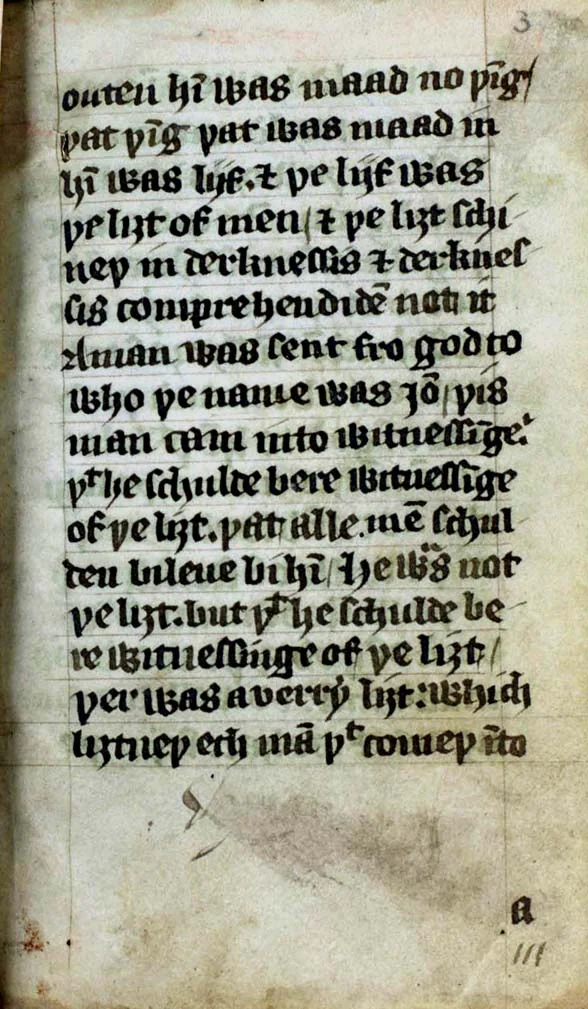 Enlarge and examine the picture
Unknown medieval scribe / University of Glasgow Library, via Wikimedia Commons · Public-domain artwork; faithful reproduction · Resized without cropping and converted to WebP · Source and rights ↗ · Licence terms
Reform within medieval Christianity
John Wycliffe was an Oxford theologian and priest whose criticism addressed clerical wealth, ecclesiastical authority and access to Scripture. He died in 1384, more than a century before Luther’s indulgence controversy. Calling him a precursor connects periods, but can make medieval debates appear merely preparatory to later Protestantism. His arguments belonged to their own intellectual and religious circumstances. Neither his followers nor Bohemian reformers should be treated as sixteenth-century Protestants born early.
A Bible made by many hands
The Wycliffite Bible tradition comprised English translations and manuscript copies associated with Wycliffe’s followers. It is unsafe to credit every translated passage or surviving volume to him personally. The illustrated Glasgow manuscript is an incomplete, portable New Testament from late-fourteenth-century England. Its original owner is unknown. Scribal copying, correction and circulation—not printing—carried these texts between readers. This page documents vernacular religious culture without proving who translated, owned or preached from this particular book.
Hus in Prague
Jan Hus became a priest in 1400 and began preaching in Czech at Prague’s Bethlehem Chapel in 1402. Wycliffe influenced his criticism of ecclesiastical abuses and his thinking about the church. Influence did not mean complete agreement: Hus did not adopt Wycliffe’s rejection of transubstantiation. His preaching also grew from Bohemian reform traditions. His De ecclesia, composed in 1412–13, drew on Wycliffe while advancing arguments that must be read in Hus’s own setting.
Constance and condemnation
Hus travelled to the Council of Constance in 1414, but was imprisoned there in November. Pressured to recant, he asked to be shown where his teaching was erroneous. The council condemned him, and he was burned on 6 July 1415. This was not a debate conducted under modern protections for religious disagreement. His death became a powerful reference in Bohemian religious conflict and later memories of persecution; subsequent developments should not be collapsed into his own career.
The Protestant chain of witnesses
Ellen G. White’s The Great Controversy places Hus and Jerome within a providential account of faithfulness under persecution. Its chapter explicitly cites Wylie. These works therefore do not always provide independent corroboration when telling similar stories. Their theological interpretation should be attributed respectfully and clearly. Manuscripts, Hus’s writings, contemporary records and scholarship establish the evidential framework; later Protestant histories show how communities remembered these figures and connected them to subsequent reform.