ATLAS / ANCIENT—PRESENT
All historyHow Atlas is sourced← Back to Atlas
Back to Atlas timeline
Israel–Palestine war and regional escalation — original Atlas editorial reconstruction

7 October 2023–7 September 2026 CE · attacks, Gaza war and regional escalation; review boundary · Middle East · War

Israel–Palestine war and regional escalation

Hamas and other Palestinian armed groups attacked communities and military sites in Israel on 7 October 2023, killing civilians and taking hostages. Israel’s ensuing military campaign in Gaza caused enormous Palestinian civilian death, destruction and displacement. Violence also spread through connected regional fronts and remained unresolved at the 7 September 2026 review boundary.

Atlas dossier · Present Day

Free device narration · synchronized English captions · transcript available

Why it matters

This history does not begin in 2023: occupation, blockade, dispossession, settlement, security, statehood and Palestinian political division form essential context. International humanitarian law protects civilians and binds all parties; documenting one population’s suffering cannot erase another’s or turn changing casualty reports into spectacle.

Date
7 October 2023–7 September 2026 CE · attacks, Gaza war and regional escalation; review boundary
Historical setting
Present Day · Middle East
People & communities
Israeli and Palestinian civilians · hostages and families · prisoners and detainees · displaced communities · medical and humanitarian workers · Hamas and other Palestinian armed groups · Israeli forces and authorities · regional actors and mediators

The 7 October attacks and Gaza campaign require separate description

Hamas and other Palestinian armed groups attacked Israeli civilian communities and military sites, killed civilians and took hostages on 7 October 2023. Israel's military campaign in Gaza then caused immense Palestinian civilian death, injury, destruction and displacement. Recording both does not equate conduct or erase responsibility.

UN Commission of Inquiry report ↗

2023 is not the beginning of the history

British Mandate rule, competing national movements, the Holocaust and regional war, the Nakba, occupation since 1967, settlement, blockade, failed diplomacy and Palestinian political division shape the conflict. Context explains structures and claims; it does not justify attacks on civilians or hostage-taking.

United Nations: history of the question of Palestine ↗

Humanitarian reporting is dated and attributed

OCHA documented continuing displacement, damaged services, aid constraints and insecurity through August 2026. Casualty and access figures change and come from identified reporting bodies, so the dossier avoids freezing them as timeless facts. International humanitarian law protects civilians and binds every party.

OCHA: humanitarian situation updates ↗

Illustrated sequence

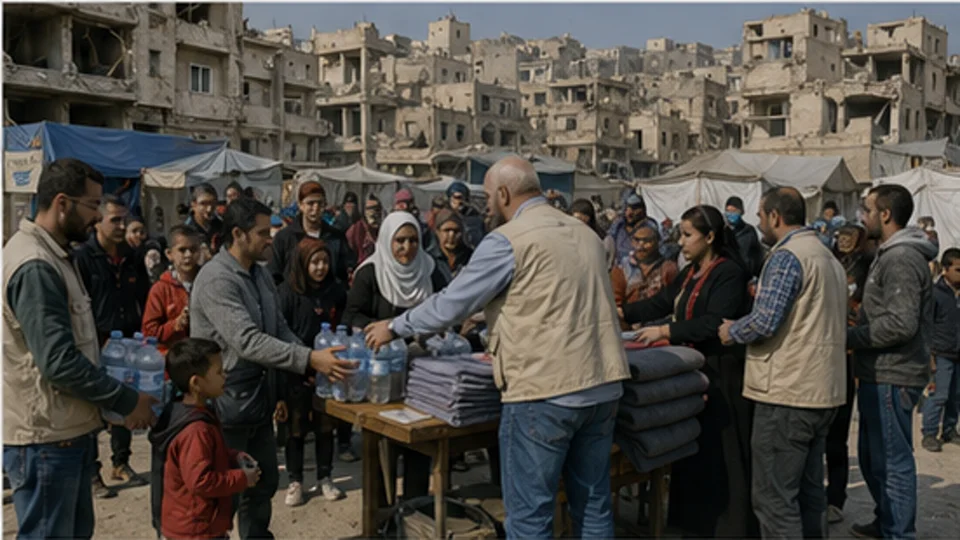
Silent pan-and-zoom motion derivative of the Israel–Palestine war and regional escalation reconstruction; not archival footage.

Interpretation note

Evidence, memory and historical debate

This dossier distinguishes the event’s basic chronology from later arguments about meaning, responsibility and legacy. When comparing religious, national, Indigenous or scholarly interpretations, consult the primary and institutional sources above alongside peer-reviewed historical work.

Elsewhere in the world

Parallel histories near this moment

25 December 2021–12 July 2022 CE · launch, commissioning and first science-image release · GlobalJames Webb Space Telescope

Webb launched on an ESA-provided Ariane 5 from French Guiana on 25 December 2021, unfolded and aligned its segmented mirror near the Sun–Earth L2 region and completed commissioning before its first public science images and spectra were released in July 2022.

30 January 2020–5 May 2023 CE · WHO global-emergency boundary; disease continues · GlobalCOVID-19 pandemic emergency

After cases of a new coronavirus disease were identified in late 2019, WHO declared a Public Health Emergency of International Concern on 30 January 2020 and characterised COVID-19 as a pandemic on 11 March. WHO ended the PHEIC on 5 May 2023 because COVID-19 had become an established, ongoing health issue—not because the virus or every pandemic consequence disappeared.

2020–2023 CE · first COVID-19 authorizations and Nobel recognition of enabling science · EuropemRNA vaccines

COVID-19 mRNA vaccines authorized in 2020 combined decades of work on messenger RNA, modified nucleosides, lipid nanoparticles, antigen design, manufacturing and clinical trials. The platform instructs cells to make an antigen; it does not alter the recipient’s genome.