1290–1224 BCE · Africa · Technology
Water lifting, gardens and irrigation along the Nile
A garden scene from the tomb of Ipuy opens a view onto the practical work of obtaining water. A counterbalanced lifting device links a simple mechanical principle with the labour required to sustain cultivation.
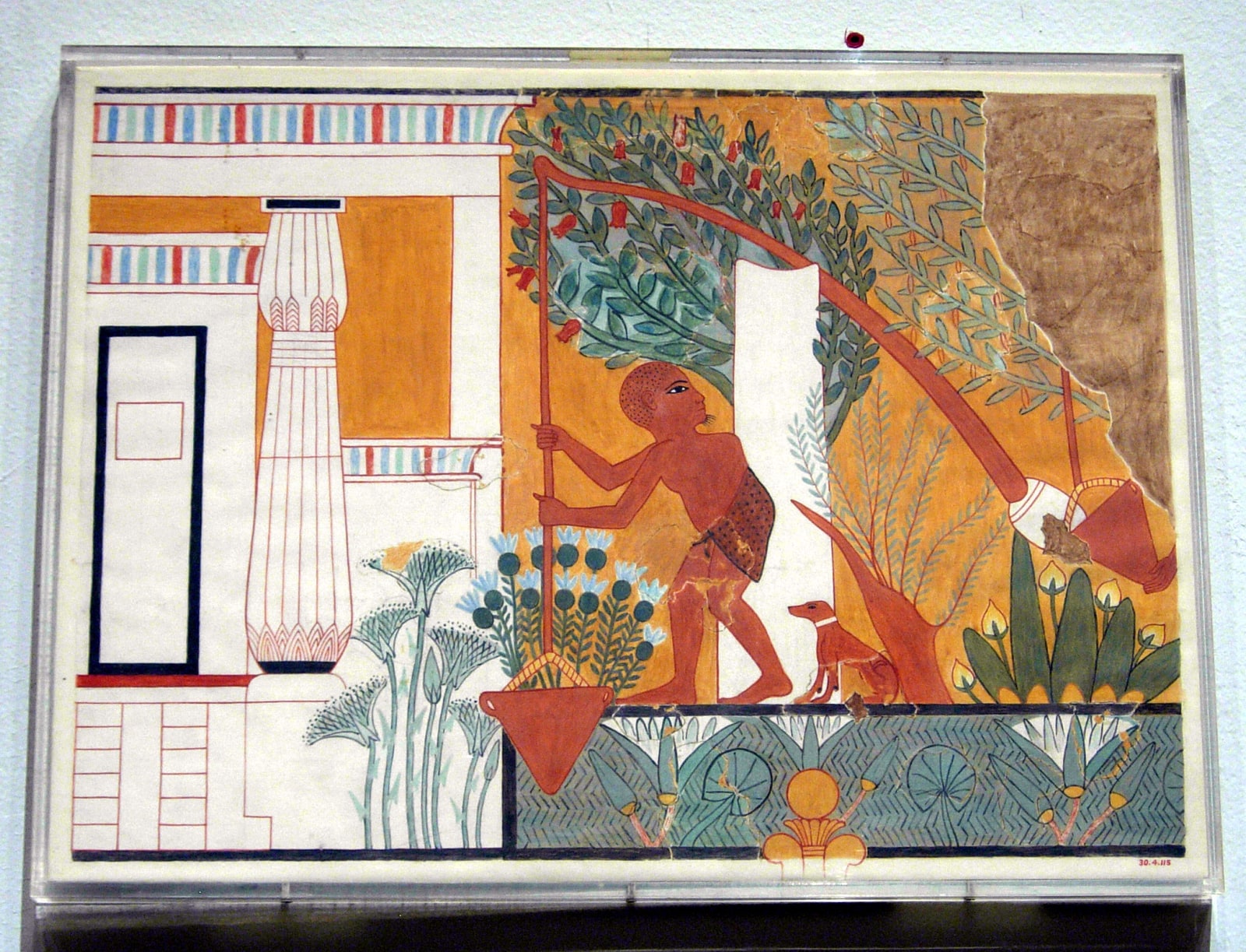 Enlarge and examine the picture
The Metropolitan Museum of Art · 30.4.115 · Public domain / Open Access · Resized for web · Source and rights ↗
Raise water with a counterweight
Follow the bucket and counterweight on opposite sides of a pivot. This view explains the lever principle while the accompanying study examines irrigation through an ancient tomb scene and a later model.

Counterweight. The weight balances part of the load and assists raising the bucket. The operator still performs work.
About this reconstruction
A teaching model, not a surveyed historical installation. An operator supplies effort; the counterweight does not create energy. Filling, emptying, human motion, rope flex and water flow are omitted. The motion is prescribed rather than a physics simulation.
Every model part, in words
- Counterweight. The weight balances part of the load and assists raising the bucket. The operator still performs work.
- Pivot and beam. The beam turns about its support, moving its two ends in opposite vertical directions.
- Bucket. The bucket lowers toward water and rises toward a bank. Filling and pouring are described rather than simulated.
An ancient scene through a later copy
The Met’s Garden Scene, Tomb of Ipuy is a tempera facsimile by Norman de Garis Davies. The museum dates the ancient scene to approximately 1290–1224 BCE, during the reign of Ramesses II, and identifies its original setting as Deir el-Medina. The displayed sheet is therefore a modern record of ancient imagery, not a piece of painted plaster taken from the tomb. The period label here refers to that original scene, not to an invention date for the device.
The lever and the load
A shaduf places a bucket and a counterweight on opposite sides of a pivoted beam. Lowering and raising the bucket transfers water toward a higher level. The weight assists the operation, but a person still supplies effort and controls the cycle. It is not a self-powered pump. In the model, the bucket motion is prescribed; filling, emptying and the operator’s movements are omitted.
Evidence from different periods
The British Museum also records a wooden model of a shaduf made by a local carpenter in Shantur, Egypt. The museum dates the model to approximately 1900–1927. It provides a later material comparison, not proof that every ancient device had identical proportions or construction. Using the tomb image and the later model together requires preserving their different dates, makers and purposes.
Technology includes work
Explaining the beam is only one part of the history. Water must be collected, lifted and distributed, and equipment maintained. An elegant mechanical diagram can conceal this labour if no person or repeated effort appears in it. Read the animation as a limited explanation of a lever, then return to the image and its setting to consider cultivation as a social practice.