1501–1722 CE · Middle East · Culture
Safavid Iran: faith, illustrated books and imperial cities
Safavid Iran connected a new dynastic and religious order with manuscript painting, textiles and urban patronage. Its visual culture belongs alongside Ottoman and Mughal histories, not inside them.
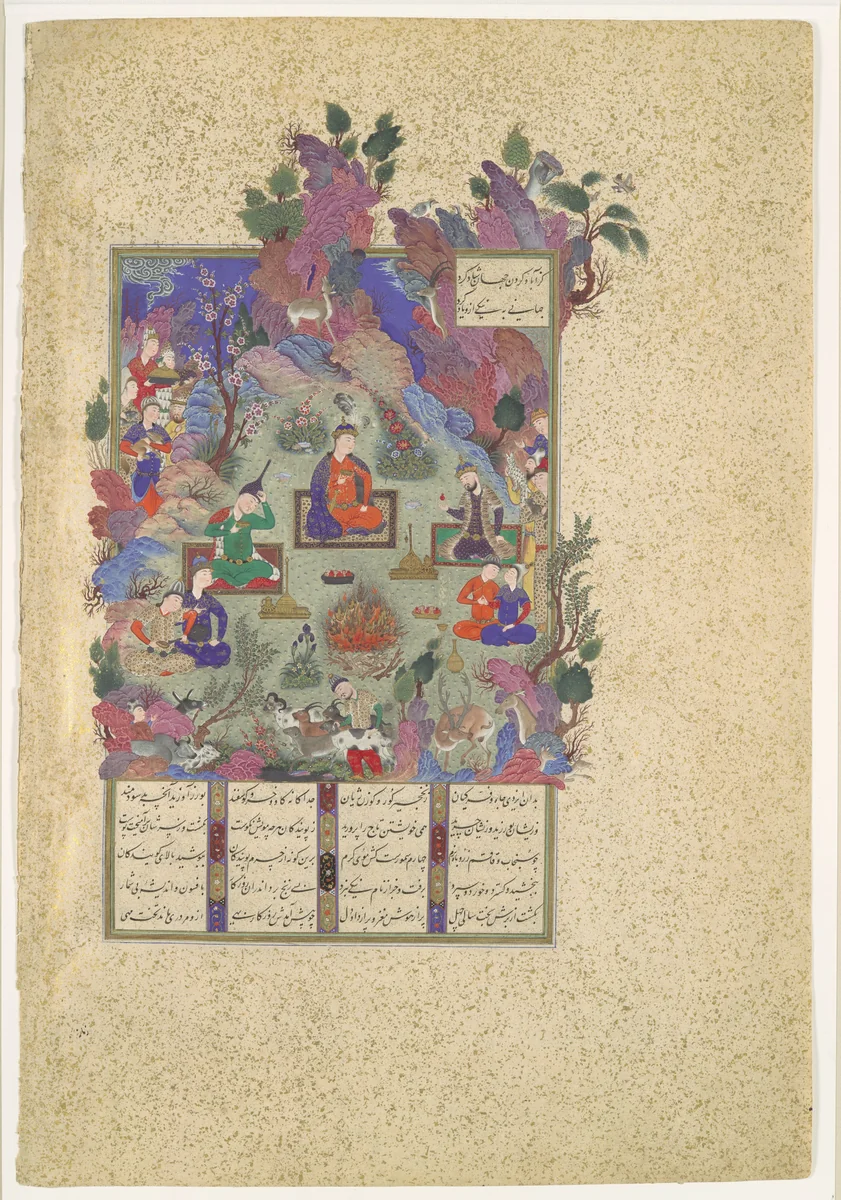 Enlarge and examine the picture
The Metropolitan Museum of Art · Gift of Arthur A. Houghton Jr., 1970 · 1970.301.2 · Public domain / CC0 · Resized and converted to WebP · Source and rights ↗ · Licence terms
A new state, not the beginning of Iranian history
The Safavids emerged from a Sufi order centred at Ardabil. Ismail took power at Tabriz in 1501 with Qizilbash support and established Shiʿi Islam as the state religion. Subsequent expansion brought a much larger territory under the dynasty. This political development should not be read as evidence that all inhabitants immediately shared one belief or identity.
Look closely at the Book of Kings
The pictured Feast of Sada belongs to Shah Tahmasp’s illustrated Shahnama and was painted around 1525, with attribution to Sultan Muhammad. It illustrates the legendary discovery of fire under Hushang. Its people, animals and mountainous composition are evidence of Safavid painting and literary patronage—not eyewitness evidence for the legendary king or the first human use of fire.
Workshops joined earlier traditions
Royal manuscript production brought together artists shaped by different court traditions, including Timurid painting. Designs also informed textiles and carpets. These objects connect skilled work, patronage and literary culture. A beautiful royal commission is not, on its own, evidence of how most people lived or of equal access to wealth.
Isfahan and a changing imperial landscape
Under Shah Abbas I, the court moved to Isfahan in 1597–98 and developed a new ceremonial centre beside the older city. Political reform, architecture and rivalry with neighbouring powers formed connected parts of the period. The dates used here mark a conventional dynastic span; they do not fill the later Afsharid, Zand, Qajar, constitutional or Pahlavi chapters of Iranian history.